A Guide to PVC Pipe Lubrication and Toughening: Striking the Perfect Balance Between Cost and Performance for Efficient, Stable Extrusion
During the production of PVC pipes and profiles, manufacturers often face severe challenges. Especially in high-speed extrusion, frequent issues such as raw material plate-out, insufficient product strength, poor surface appearance, and low yield rates create additional cost and time pressures. Striking a balance between high performance and cost-efficiency to capture a larger market share has become the primary dilemma for producers.
Addressing this core challenge, RALLYCHEM’s polyester homopolymers and polyester waxes provide the ultimate solution for PVC pipes and profiles. We deeply understand producers’ urgent needs for superior product performance, stable production, and cost optimization. With RALLYCHEM’s exclusive product formulations, you can manufacture stronger, more resilient PVC products with excellent surface gloss. Simultaneously, our solutions perfectly meet the cost-control requirements for non-standard products, adding exceptional quality and core competitiveness to your offerings.

Different types of pipes have completely different requirements for formulations and lubrication systems. Understanding your specific application is the first step in selecting the right additives:
These pipes have extremely strict standards for toughness, rigidity, impact resistance, and surface quality. The addition of calcium carbonate in the formulation is usually strictly controlled: the filling amount for national standard pipes is generally under 25 phr (parts per hundred resin), while for irrigation pipes requiring pressure resistance, it is only around 8-10 phr. This demands an exceptional balance of internal and external lubrication, as well as high resistance to plate-out.
For conduit pipes, extrusion speed is everything—it directly determines production costs and market competitiveness. The formulation must pursue excellent flowability and plate-out resistance, ensuring that both the inner and outer walls of the pipe remain perfectly smooth.
These are extremely difficult to produce! Large-diameter pipes must use organotin stabilizers paired with high-density oxidized wax. Without this combination, it is impossible to meet the requirements for plasticization degree, production stability, extrusion speed, and plate-out resistance.
This includes non-standard drainage pipes or heavily calcium-filled conduit pipes with filling volumes as high as 100-150 phr. The core challenge for these end-products is how to maintain continuous processing and basic mechanical properties under such extreme powder filling.
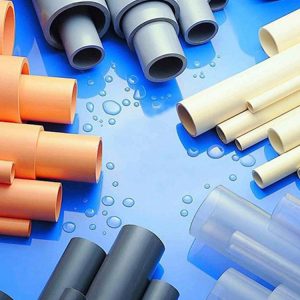
To achieve stable extrusion and resolve the pain points mentioned above, RALLYCHEM offers highly targeted, high-performance polymer and lubricant solutions:
Maximized Performance: Specially developed for PVC/CPVC, it provides both high toughness and rigidity. It grants the product excellent low-temperature impact resistance (preventing embrittlement in extreme cold) while offering auxiliary thermal stability and improved flowability.
Miraculous Cost Reduction: The dosage is only 50%–70% of traditional CPE. Even more surprisingly, it can reduce the total amount of lubricants in the formulation by 10%–30%. It significantly optimizes formulation costs while drastically enhancing the strength and toughness of the pipes.
Application Scenario: Highly suitable as the primary lubricant for conventional PVC pipe production.
Product Advantages: It can significantly reduce or even entirely replace stearic acid, Fischer-Tropsch wax, or partial PE wax in the formulation. It perfectly matches the demands for high-speed extrusion, high flowability, and strong plate-out resistance, ensuring perfectly smooth inner and outer pipe walls.
Application Scenario: Recommended only for large-diameter pipes. It is generally not used in formulations for small-diameter conduit pipes.
Product Advantages: Its plasticization speed is extremely aggressive for PVC. With high viscosity and relatively slower flowability, it is purpose-built to tackle the severe plasticization difficulties and high-shear challenges of thick-walled, large-diameter pipes.
Application Scenario: National standard pipes, conduit pipes, and production lines prone to plate-out in the vacuum calibration sleeve.
Product Advantages: As a commonly used external lubricant for PVC pipes, RALLYCHEM’s PE WAX boasts outstanding anti-plate-out properties and robust late-stage lubricating capabilities, thoroughly eliminating the persistent problem of plate-out accumulation in the vacuum sizing sleeve.

When evaluating lubricant options for your PVC pipe extrusion line, please check the following indicators:
Selecting the optimal lubrication and toughening system is the only way to achieve efficient, stable, and high-quality production for PVC pipes. RALLYCHEM’s polyester homopolymers, various oxidized waxes, and high-performance PE waxes build a solid moat for your business—not only reducing friction, improving processing stability, and solving annoying plate-out issues, but also tangibly lowering your overall formulation costs.
Whether you are producing high-speed conduit pipes, high-standard national water and drainage pipes, or challenging 300mm+ large-diameter pipes, RALLYCHEM can provide a tailor-made solution for you.
Contact RALLYCHEM today for professional technical guidance, free trial samples, and highly competitive quotes to comprehensively elevate the competitiveness of your PVC pipe products!
Bạn có thể quan tâm
2026 Market Trends: How Water Based Wax Emulsion is Powering Key Industries
2026 / 03 / 04
PVC Pipe & Profile Processing: Why Heat Stabilizers Are Essential—and Why Wax Additives Inside Stabilizer Packages Matter
2026 / 02 / 24
What Does “High Density” Mean in Oxidized Polyethylene Wax?
2026 / 02 / 17
How Polyethylene Wax Enhances Pigment Dispersion and Color Consistency in Masterbatch Production
2026 / 02 / 05
Cost Optimization in PVC Processing: Using Targeted Polyester Wax to Partially Replace Stearic Acid and Paraffin Wax
2026 / 02 / 04




Để biết thêm thông tin, vui lòng liên hệ qua số điện thoại.
Rallychem rất hân hạnh được hỗ trợ quý khách!
+86 13456396233




 Tiếng Anh
 Tiếng Tây Ban Nha
 Pháp
Pháp Nhật Bản
 Hàn Quốc
 Tiếng Ả Rập
 Ba Tư
Ba Tư Đức
Đức Ý
Ý Việt Nam
 Thái
Thái Nga
Nga Indonesia
 Malay
Malay Thổ Nhĩ Kỳ


