In commodity plastic processing — PP, PE, PVC — lubricant selection is forgiving. PE wax, paraffin, and stearates all get the job done.
But when the material becomes PA, PC, PBT, or PU, the rules change entirely. The wrong lubricant can compromise surface appearance, reduce mechanical properties, or cause demolding failure and part rejection.
This is why engineering plastics demand a special kind of wax.
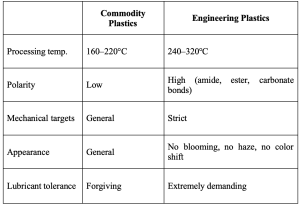
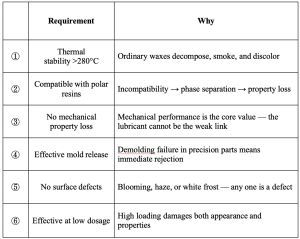
All six must be met — none can be skipped.
Montan wax, extracted from lignite, is built around C26–C32 long-chain wax esters — a molecular structure that happens to align precisely with all six engineering plastic requirements.

Six requirements, all met — this is why Montan wax has long been the benchmark.
Other Common Options
PETS — Balanced internal/external lubrication; good for PC, PBT
EBS (amide wax) — Strong external lubrication and mold release; PA, ABS
Maleic anhydride-grafted wax — High polarity; glass-fiber-filled systems
EAA wax — Combined lubrication and dispersion; high-filler formulations

Despite its performance, Montan wax has persistent limitations:
① Purity — Even after refining, residual resins, short-chain hydrocarbons, and pigments remain. These volatilize under high heat, generating odor, smoke, and accelerating mold deposit buildup.
② Batch inconsistency — Acid value, saponification value, and color can shift from batch to batch, forcing formulation engineers to constantly re-adjust recipes.
③ Supply chain vulnerability — Montan wax depends on specific lignite mining regions. Any disruption — at the mine, in logistics, or geopolitically — directly exposes customers to supply risk.
These three pain points are exactly what drove the development of synthetic polyester wax.
① Cleaner
Synthesized from pure alpha-olefin feedstocks with precisely controlled processes. Significantly lower low-molecular-weight impurity content means less smoke, slower mold deposit buildup, and cleaner part surfaces.
② More Consistent
Acid value, saponification value, and softening point are tightly controlled batch to batch — no formulation re-adjustment needed.
③ More Reliable
Production facilities operating in China and Vietnam, with expansion planned in Egypt and Mexico. No mining dependency. No single-source risk. No supply interruptions.
④ More Cost-Effective
Synthetic production avoids the mine–extract–refine cost chain of natural wax. Equivalent performance at a price significantly below imported Montan wax.
⑤ More Flexible — Fully Customizable
Natural Montan wax cannot be adjusted — its molecular structure is fixed by geology. Rallychem synthetic polyester wax is tunable to order:

One product platform. Compatible with PA6, PA66, PC, PBT, PU — and customizable for each.

Lubricant selection in engineering plastics is about balancing three things at once:
Processing efficiency — clean demolding, no sticking, no smoke
Product quality — no blooming, no defects, mechanical targets met
Long-term stability — consistent batches, reliable supply, minimal formulation adjustment
Rallychem synthetic polyester wax is engineered to deliver all three.
Bạn có thể quan tâm
Hướng dẫn bôi trơn và tăng cường độ bền cho ống PVC: Tìm kiếm sự cân bằng hoàn hảo giữa chi phí và hiệu suất để đạt được quá trình đùn hiệu quả và ổn định
2026 / 03 / 19
Xu hướng thị trường năm 2026: Cách thức mà nhũ tương sáp gốc nước đang thúc đẩy các ngành công nghiệp chủ chốt
2026 / 03 / 04
Chế biến ống và thanh nhựa PVC: Tại sao chất ổn định nhiệt lại không thể thiếu — và tại sao các chất phụ gia sáp trong các gói chất ổn định lại quan trọng
2026 / 02 / 24
“Mật độ cao” trong sáp polyethylene oxy hóa có nghĩa là gì?
2026 / 02 / 17
Cách sáp polyethylene cải thiện khả năng phân tán bột màu và độ đồng đều màu trong sản xuất hỗn hợp màu
2026 / 02 / 05




Để biết thêm thông tin, vui lòng liên hệ qua số điện thoại.
Rallychem rất hân hạnh được hỗ trợ quý khách!
+86 13456396233





 Tiếng Anh
 Tiếng Tây Ban Nha
 Pháp
Pháp Nhật Bản
 Hàn Quốc
 Tiếng Ả Rập
 Ba Tư
Ba Tư Đức
Đức Ý
Ý Việt Nam
 Thái
Thái Nga
Nga Indonesia
 Malay
Malay Thổ Nhĩ Kỳ


