Have you ever run into this?
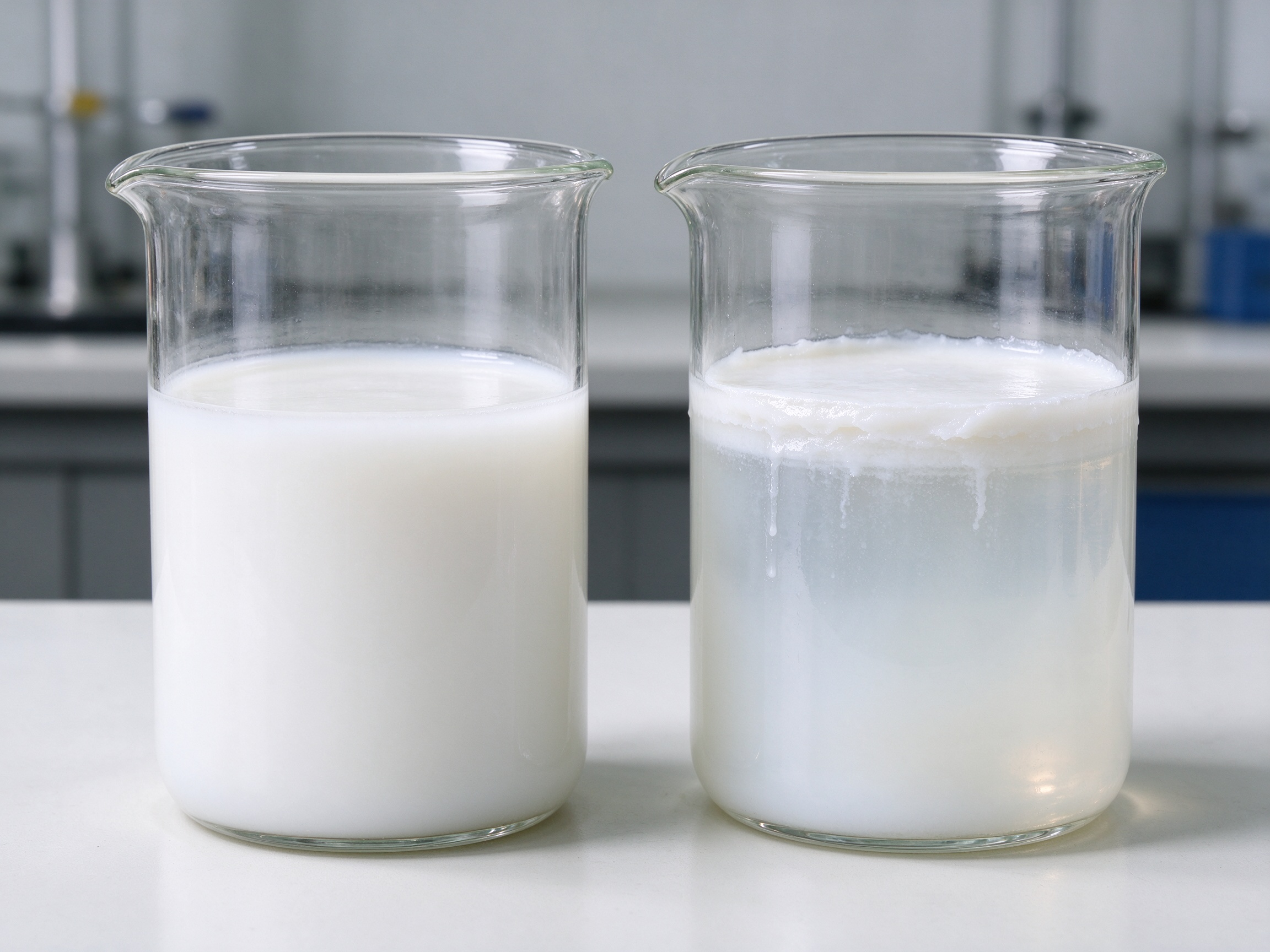
A batch of wax emulsion comes off the line. Sampling confirms that appearance, solid content and pH all pass. The emulsion is uniform and fine. It is sealed and put into storage for later use. Then, after sitting for a while, when the lid comes off ahead of production, a clear wax layer is found floating on the surface.
You investigate: the packaging was sealed, the temperature and humidity logs for the storage area are complete, and storage conditions were fully within specification.
With every external storage variable ruled out, the root cause is not the storage environment — the instability was built into the emulsion the moment it left the reactor.
Creaming is one of the most common and most troublesome failure modes in industrial wax emulsion production. Its most awkward property is that it is delayed: nothing looks wrong immediately after preparation, and the defect only surfaces once the product has been sitting in storage.
When it does, how do you trace it back and build a corrective plan? This article walks the full production process, step by step, to break down the root causes and give you the corresponding countermeasures.
Creaming is the upward migration of wax droplets under gravity. Wax is less dense than water, so fine droplets rise slowly over time; once droplets coalesce and grow larger, the rate of rise accelerates sharply, and a visible layer forms at the surface.
Shear during emulsification determines the formation of the initial particles and their size distribution. Once emulsification is complete, the system’s long-term stability depends on particle size, interfacial protection, the properties of the continuous phase, and the structure formed as the wax phase cools and crystallizes. If the film is not strong enough, droplets keep merging and growing on collision; coarsened droplets rise faster, and separation appears.
This also explains why storage factors have been ruled out: the seeds of separation are planted in the formulation and the process before the product is discharged, not in mishandling after filling.

Wax does not dissolve in water. A stable wax emulsion depends on three fundamentals: a fully molten wax phase, sufficient mechanical shear, and an emulsifier system matched to the wax. If any one of them fails, creaming can follow. Checking the full production process, link by link:
If the wax is not fully molten before emulsification, solid debris remains. That debris cannot be sheared into fine droplets — it can only rise and form a layer as coarse particles.
Another frequent problem is the wrong emulsifier system: A mismatch between the emulsifier system and the properties of the wax phase may result in inadequate interfacial protection or poor particle dispersion, ultimately causing creaming and phase separation. For suitable nonionic emulsifier systems, HLB can be used as one reference for formulation screening, alongside particle size, storage stability, and performance in actual applications.
This link is especially critical for high-melting-point waxes.
If stirring shear is insufficient, the molten wax cannot be broken into fine, uniform droplets. By Stokes’ law, doubling the droplet diameter multiplies the rise velocity by four; coarse particles migrate far faster than fine ones.
If pressure control during emulsification is unstable, the aqueous phase boils prematurely. Steam bubbles disrupt the dispersion, generating coarse particles and broadening the particle size distribution.
The order of water addition, the water temperature and the feed rate are often underestimated.
Adding cold water, or adding too quickly, subjects the molten wax phase to thermal shock: the temperature drops abruptly and the wax solidifies locally before dispersion is complete. If the holding time is too short, the emulsifier cannot fully adsorb onto the droplet surface, and droplets without a protective layer agglomerate during subsequent storage.
If the cooling rate is too fast, or stirring is stopped before the wax has fully solidified, droplets merge and coarsen while still soft. Even if the discharge looks normal, coarsening continues through cooling and storage until a cream layer appears.
If filtration is ineffective, agglomerated coarse wax particles are not removed. During storage, these coarse particles act as nucleation sites, continuously triggering further aggregation.
When you handle a separated sample, the first step is not to touch the formulation, but to distinguish reversible creaming from irreversible breakdown:

Many customers come to us after repeated failed production trials: the discharge looks fine, and then it creams in storage. Once storage factors are excluded, the root cause sits in the formulation system or on the production line.
We do not hand out generic formulations, and we do not pin the blame on a single raw material. Instead, we locate the fault along the process:
Joint formulation and process optimisation:
Where formulation mismatch is the main cause: we recommend a suitable wax grade, develop a custom emulsifier blend, adjust HLB to your wax system, and provide laboratory samples for stability verification.
Creaming is rarely the result of a single operational error. It is usually a mismatched emulsifier formulation, insufficient shear, a poorly controlled water addition process and uncontrolled cooling, stacking on top of one another.
The appearance at discharge only proves that a batch “looks qualified”. What really decides the product’s fate is storage stability — and storage stability is determined jointly by the formulation and the entire process.
If your wax emulsion is suffering from creaming, phase separation or a short shelf life, please contact the Rallychem team. Tell us what you are seeing, and we will carry out laboratory analysis and technical assessment and propose targeted formulation or process adjustments.
You can also read our industry article: 2026 Market Trends: How Water-Based Wax Emulsion Is Powering Key Industries to learn more about wax emulsion technology.
Rallychem | Wax additive supplier and wax emulsion technology partner — diagnosing stability defects, optimising your production process.
Rallychem | From wax additives to technical support for the wax emulsion manufacturing process.
You May Be Interested
Stable in the Lab, Flocculating in Production: Is This Drum of Wax Emulsion Really to Blame?
2026 / 10 / 21
Three Months at a Masterbatch Plant: From Raising Throughput to Strand Breaks — and Rebuilding the Formulation Balance
2026 / 10 / 21
More possibilities for coatings and inks, see you in Guangzhou.
2026 / 10 / 21
Why Do Wax Additive Replacement Tests Fail? Why Can Similar TDS Parameters Still Lead to Different Processing Results?
2026 / 10 / 19
The Hidden Trap of High-Filler PVC Pipe Formulations: Why Does Increasing Calcium Carbonate Loading Lead to More Severe Die Build-Up?
2026 / 10 / 14




For Inquiries Please Call
Rallychem Will Be Happy To Assist You!
+86 13456396233






 English
 Español
 Français
 日本語
 한국어
 العربية
 فارسی
 Deutsch
 Italiano
 Tiếng Việt
 ไทย
 Русский
 Bahasa Indonesia
 Bahasa Melayu
 Türkçe


