Una emulsión de cera a base de agua puede permanecer estable durante el almacenamiento, pero comportarse de manera diferente una vez que se agrega a la formulación del cliente. Aquí es donde comienzan muchos problemas de formulación: un producto que parece perfectamente estable por sí solo puede mostrar cambios de viscosidad, separación, floculación o rendimiento de aplicación reducido después de mezclarlo con resinas, pigmentos u otros aditivos.
Eso significa que evaluar la emulsión de cera en sí es sólo una parte del proceso. Para los formuladores, la pregunta más importante es si puede mantener la estabilidad y el rendimiento adecuados después de ingresar a la formulación completa.
Esto es particularmente importante en recubrimientos, tintas, textiles, acabados de cuero y otros sistemas a base de agua, donde las emulsiones de cera se combinan con múltiples componentes de formulación y pueden experimentar diferentes condiciones de almacenamiento o procesamiento.
Una evaluación de la estabilidad más centrada en la aplicación puede ayudar a identificar posibles problemas de compatibilidad antes, reducir las pruebas y errores innecesarios y respaldar una selección de emulsión de cera más informada.
¿Cómo funciona la estabilidad de la emulsión de cera a base de agua?
A primera vista, un
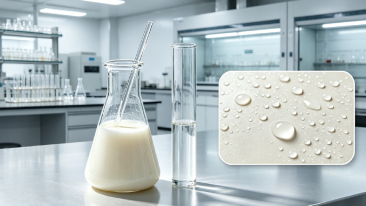
emulsión de cera a base de agua puede parecer nada más que un simple líquido blanco. Sin embargo, detrás de esta apariencia se esconde un sistema de dispersión cuidadosamente controlado, en el que innumerables partículas diminutas de cera se distribuyen uniformemente en agua y se estabilizan mediante componentes emulsionantes.
La estabilidad de este sistema de dispersión es esencial porque afecta directamente si la emulsión de cera puede mantener un rendimiento constante durante el almacenamiento, la mezcla de la formulación y la aplicación final. Una emulsión de cera estable ayuda a garantizar una distribución uniforme de la cera en el sistema, lo que permite que propiedades como deslizamiento, resistencia a la abrasión, repelencia al agua y sensación de superficie se entreguen de manera consistente.
Es un error común pensar que la estabilidad de la emulsión de cera sólo depende de si la propia emulsión permanece estable durante el almacenamiento. En realidad, la estabilidad no se limita al estado de la emulsión original, sino que también depende de qué tan bien la emulsión de cera mantiene su dispersión y rendimiento después de incorporarse a un sistema de formulación completo.
Durante la formulación, el almacenamiento y la aplicación, los cambios en el pH, el ambiente iónico, la temperatura y las interacciones con otros componentes pueden alterar este equilibrio y afectar el rendimiento final del sistema.
Cuando este delicado equilibrio se altera, el sistema puede mostrar gradualmente problemas de estabilidad, tales como:
-
Separación de fases o cremado
-
Floculación o sedimentación
-
Viscosidad aumentada o inestable.
-
Coagulación después del ajuste del pH.
-
Reducción del deslizamiento, resistencia a la abrasión u otro rendimiento de la superficie.
Para mantener este equilibrio en diferentes condiciones de formulación, es importante comprender los factores clave que pueden influir en la estabilidad de la emulsión de cera.
4 factores clave a considerar al evaluar la estabilidad de una emulsión de cera
Aunque la estabilidad de la emulsión de cera está influenciada por muchos factores, la mayoría de los problemas de estabilidad observados durante el desarrollo de la formulación generalmente se remontan a varias áreas clave. Comprender estos factores ayuda a los formuladores a identificar las posibles causas de la inestabilidad de manera más eficiente y a realizar ajustes específicos en lugar de depender de repetidos ensayos y errores.
1.pH
El pH suele ser el primer parámetro que se debe comprobar al solucionar problemas de una emulsión de cera inestable. Los cambios en el pH pueden afectar el estado de ionización de ciertos componentes emulsionantes y las interacciones entre las partículas dispersas y otros ingredientes de la formulación. La sensibilidad al pH depende en gran medida del sistema de emulsificación y de la química de la cera.
Si la formulación se sale del rango de pH adecuado, el mecanismo de estabilización puede volverse menos efectivo, aumentando el riesgo de agregación de partículas o separación de fases.
Para una mejor estabilidad:
-
Verifique el pH de la formulación base antes de agregar la emulsión de cera.
-
Evite agregar ácido o álcali concentrado directamente a la emulsión.
-
Realice ajustes de pH gradualmente.
-
Vuelva a comprobar la estabilidad después de que la formulación se haya equilibrado.
El rango de pH adecuado varía según la química de la cera y la tecnología de emulsificación. Por lo tanto, se deben considerar los datos técnicos del proveedor durante el desarrollo de la formulación.
2. Tolerancia a los electrolitos
Los electrolitos son otro factor que merece atención. Las sales, pigmentos, agentes neutralizantes, tensioactivos iónicos y otras materias primas pueden aumentar la fuerza iónica de una formulación y afectar la estabilidad de la dispersión.
Una fuerza iónica más alta puede reducir las fuerzas de repulsión entre partículas dispersas, lo que puede aumentar la posibilidad de agregación.
Esto es particularmente importante para formulaciones que contienen niveles relativamente altos de:
-
Sales inorgánicas
-
pigmentos y cargas
-
Agentes neutralizantes
Si aparece inestabilidad después de agregar un ingrediente específico, se recomienda evaluar ese componente por separado en lugar de simplemente aumentar la dosis de cera. En algunos casos, cambiar la secuencia de adición o el método de dilución puede mejorar la compatibilidad.
3. Compatibilidad con otros aditivos
En formulaciones reales, las emulsiones de cera se usan comúnmente junto con resinas acrílicas o de poliuretano, pigmentos, dispersantes, antiespumantes, agentes humectantes, modificadores de reología, conservantes y otros aditivos.
Estos componentes pueden cambiar el pH, la fuerza iónica, la viscosidad o la química de la superficie del sistema. Por tanto, su interacción con la emulsión de cera puede afectar a la formulación final.
Por ejemplo, un recubrimiento puede parecer uniforme inmediatamente después de mezclarlo, pero desarrollar cambios de viscosidad o separación durante el almacenamiento. En otra formulación, la apariencia puede permanecer estable mientras cambian el deslizamiento, la resistencia a la abrasión o la sensación de la superficie.
Por lo tanto, una prueba práctica de compatibilidad puede incluir:
-
Aspecto después de mezclar: verifique si hay floculación, coagulación o separación.
-
Viscosidad: compare la formulación antes y después de la adición de cera y controle los cambios durante el almacenamiento.
-
Estabilidad durante el almacenamiento: verifique si la formulación completa permanece dentro de las condiciones físicas esperadas.
-
Rendimiento de la aplicación: evalúe propiedades como deslizamiento, resistencia a la abrasión, repelencia al agua, antibloqueo o sensación de la superficie según la aplicación.
4. Temperatura y condiciones de almacenamiento
Las condiciones de temperatura y almacenamiento pueden volverse importantes cuando una emulsión de cera experimenta condiciones diferentes a las del entorno estándar de laboratorio.
Las altas temperaturas, las bajas temperaturas, los ciclos de congelación y descongelación, las fluctuaciones repetidas de temperatura, el almacenamiento prolongado y las condiciones de transporte pueden influir en la estabilidad física de una emulsión de cera a base de agua.
Por ejemplo, la congelación puede alterar la estructura de la dispersión y algunos sistemas pueden mostrar cambios en la viscosidad, sedimentación o separación después de la descongelación. La exposición prolongada a temperaturas elevadas también puede contribuir a cambios en la viscosidad o la apariencia, según la formulación.
Para productos que puedan experimentar transporte en climas fríos, cambios de temperatura estacionales o tiempos de entrega prolongados, estas condiciones pueden incluirse en la evaluación cuando sea relevante.
Las pruebas pueden incluir:
-
Almacenamiento a alta y baja temperatura
-
Ciclos de congelación-descongelación
-
Fluctuaciones de temperatura
-
Almacenamiento extendido
-
Condiciones de transporte
Las condiciones de almacenamiento también pueden afectar la estabilidad microbiológica. Si aparecen olores, moho u otras anomalías durante el almacenamiento a largo plazo, la causa debe investigarse por separado en lugar de atribuirla automáticamente a la inestabilidad física de la emulsión.
Cómo Rallychem respalda las soluciones personalizadas de emulsión de cera
Cuando los clientes encuentran problemas de estabilidad de la emulsión de cera, Rallychem primero analiza la formulación real y las condiciones de aplicación en lugar de simplemente recomendar un producto diferente. Esto nos ayuda a evaluar si la emulsión de cera seleccionada permanece estable y funciona como se esperaba en la formulación del cliente.
La evaluación puede incluir:
-
Compatibilidad con resinas y aditivos
-
Condiciones de pH y electrolitos.
-
Método de mezcla y secuencia de adición.
-
Condiciones de almacenamiento y transporte.
Por ejemplo, si la viscosidad cambia después de agregar la emulsión de cera a un sistema de recubrimiento, podemos examinar la interacción con la resina u otros aditivos. Si aparece separación después del almacenamiento o transporte, es posible que también sea necesario considerar la temperatura y las condiciones de almacenamiento.
Según los resultados de la evaluación, Rallychem puede recomendar grados de emulsión de cera adecuados, ajustes de formulación o muestras para pruebas adicionales. Nuestro objetivo es ayudar a los clientes a identificar una solución que funcione no solo como un producto independiente, sino también dentro de su formulación real.
Con experiencia en recubrimientos, tintas, textiles, acabados de cuero, papel y otras aplicaciones acuosas, Rallychem ofrece soluciones de emulsión de cera personalizadas basadas en requisitos específicos de formulación y aplicación.
Conclusión
La estabilidad de la emulsión de cera a base de agua debe evaluarse desde más de una perspectiva. Para el desarrollo real de una formulación, vale la pena considerar cuatro áreas: pH, tolerancia a electrolitos, compatibilidad con otros aditivos y condiciones de temperatura y almacenamiento.
Probar la emulsión de cera en la formulación objetivo y en condiciones de aplicación o almacenamiento relevantes puede proporcionar información más útil para la selección del producto que confiar únicamente en datos de estabilidad independientes.
La clave no es sólo entender si la emulsión de cera es estable por sí sola, sino también si sigue siendo adecuada después de ingresar a la formulación del cliente.












 English
  Español
  Français
  日本語
日本語  한국어
한국어  العربية
  فارسی
فارسی  Deutsch
  Italiano
  Tiếng Việt
  ไทย
ไทย  Русский
  Bahasa Indonesia
  Bahasa Melayu
  Türkçe


