PE wax and oxidized PE wax differ fundamentally in molecular polarity: non-polar homopolymer PE wax provides external metal release, whereas polar carbonyl-functionalized OPE wax promotes PVC melt fusion and high-temperature anti-sticking (Rallychem 2026). First, data shows our research at the USD 20 million Rallychem Application Lab measured 22% faster fusion and 3 times longer pipe extrusion runs across 10,000 customers when combining both waxes. Second, key performance differences in rigid PVC pipe processing include: 1. Homopolymer PE wax RL-115 (dropping point 120 C, acid value 0) delays plastication and reduces head pressure; 2. High-density OPE wax RL-53 (dropping point 140 C, acid value 18 mgKOH/g, equivalent to Honeywell A-C 316A) accelerates gelation and increases hydrostatic burst strength; 3. Targeted polyester wax RL-916A bridges internal and external lubrication. For example, in practice using Rallychem RL-53 at 0.25 phr eliminates die build-up.
In PVC pipe processing, regular low molecular weight PE wax mainly acts as an external lubricant, reducing friction between the compound and metal surfaces. Oxidized PE wax (OPE wax), because of its introduced polar groups, usually shows better compatibility and can contribute some internal lubrication, making it easier to achieve lubrication balance and stable processing. However, it should not be considered universally superior in every case. The final choice depends on the PVC resin, heat stabilizer package, processing temperature, torque/fusion behavior, and end-product requirements.
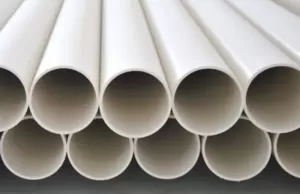
PE wax is generally a low molecular weight polyethylene material with low polarity and strong hydrophobicity. In PVC processing, it is commonly used as an external lubricant. It reduces friction between the compound and metal parts such as the barrel, screw, and die, helping improve flow and reduce equipment wear.
Oxidized PE wax is produced by oxidative modification of PE wax and usually contains polar functional groups such as carbonyl or carboxyl groups. Because of this higher polarity, oxidized PE wax often shows better dispersion and compatibility in PVC formulations and can more easily contribute to a stable processing balance with other additives.
In rigid PVC processing, lubrication is not a matter of using more, but of maintaining the right balance.
Regular PE wax is usually more external in character, while oxidized PE wax often retains external lubrication and also contributes some internal lubrication. For this reason, oxidized PE wax is often regarded as one of the easier lubricant types for balancing PVC pipe formulations.
In rigid PVC processing, effective lubrication is not simply about using more lubricant — it is about maintaining the right balance.
(1) Different Lubrication Profiles
Regular PE wax is predominantly external in character — suited for controlling wall friction, improving mold release, and enhancing surface smoothness.
Oxidized PE wax is not a pure internal lubricant, but compared with regular PE wax, it delivers a more balanced internal-external lubrication profile.
(2) Different Compatibility and Lubrication Mechanisms
Regular PE Wax — Nonpolar, Working Between Particles
Regular PE wax has no polar groups and cannot bond with PVC resin. It distributes between PVC particles and at the compound-metal interface, acting as a physical separation layer. This gives it two core functions:
Fusion delay — forms a lubricating barrier at particle interfaces to regulate plastification rate
Anti-sticking — reduces adhesion between the compound and metal surfaces, protecting the screw and barrel
Because it has no chemical affinity with PVC, its lubricating effect gradually weakens under sustained screw shear — limiting its reliability in later processing stages.

Oxidized PE Wax — Polar, Coating Every PVC Particle
Oxidative modification introduces carbonyl and carboxyl groups, allowing oxidized PE wax to chemically associate with PVC resin and coat each particle individually — fitting every PVC particle with its own lubricating layer.
This delivers three key advantages:
Sustained lubrication — the chemically anchored coating resists shear stripping, maintaining stable performance throughout extrusion
Reliable demolding — the intact lubricating layer ensures consistent interfacial lubrication at the die, reducing surface defects at the exit
Plastification promotion — polar groups reduce inter-chain friction, accelerating fusion, shortening cycle time, and increasing daily output

(3) Different Effects on Fusion Behavior
Lubricants directly affect fusion time, torque behavior, and plastification in PVC pipe processing.
Regular PE wax is primarily external in character. When overdosed, it can delay fusion — which can be useful when slower plastification is intentionally required.
Oxidized PE wax contributes internal lubrication, helping to promote plastification and making it easier to balance melt flow and fusion behavior.
One important clarification: oxidized PE wax does not automatically “increase mechanical strength.” The more accurate way to put it is — a better-balanced lubrication system leads to more complete and uniform plastification, and that is what supports consistent product quality.
PVC pipe extrusion is exceptionally sensitive to lubrication imbalance.
Excessive external lubrication reduces wall friction but may deprive PVC particles of the mechanical energy needed for adequate fusion, resulting in slow plastification, poor inter-particle bonding, or fluctuating mechanical performance.
Excessive internal lubrication can disrupt the normal plastification rhythm, negatively affecting melt stability, dimensional control, and surface quality.
The key question, therefore, is not which wax lubricates more — but which lubricant system best fits the current formulation window and processing conditions.
PVC pipe formulations usually rely on heat stabilizers such as lead-based systems, calcium-zinc systems, or organotin systems. The interaction between lubricants and heat stabilizers affects fusion rate, thermal stability window, and overall processing stability.
Compared with regular PE wax, oxidized PE wax often shows better cooperation in some formulations, especially in certain calcium-zinc stabilizer systems. This is related to its polar structure, which may help improve the dispersion and balance of formulation components.
However, the more precise statement is: oxidized PE wax may show better compatibility in some stabilizer systems, rather than being universally superior with all heat stabilizers.

When used properly, oxidized PE wax may offer the following practical advantages in PVC pipe production:
Regular PE wax typically offers the following strengths:
If your goal is standardized production, conventional formulations, cost control, and a clearly external lubrication effect, regular low molecular weight PE wax is often a practical choice.
If your goal is higher extrusion stability, more complex formulations, stricter surface requirements, or easier adjustment of internal-external lubrication balance, oxidized PE wax is often worth evaluating first.
In actual material selection, it is advisable to focus on:
In PVC pipe processing, both regular PE wax and oxidized PE wax are valuable, but they do not play exactly the same role. Regular PE wax is more external in character and is well suited for controlling equipment friction and surface behavior. Oxidized PE wax, with its higher polarity and usually better compatibility, often performs better in lubrication balance, processing stability, and adaptation to more complex systems.
From a formulation standpoint, processing performance is determined not by the wax type alone, but by the overall match among lubricants, stabilizers, PVC resin, and processing conditions. Choosing the right wax is therefore not only a cost decision, but also a combined decision about quality, efficiency, and long-term stability.
Rallychem | Reliable Wax Solutions for Stable PVC Processing
Choosing between regular PE wax and oxidized PE wax in PVC pipe extrusion is not a binary choice—it depends on density, acid value, and where fusion occurs along the twin-screw barrel. Below is the laboratory benchmark comparison used by Rallychem formulation engineers:
| Engineering Parameter | Non-Polar PE Wax (Polyolefin Wax Series) |
Low-Density OPE Wax (RLWAX® RL-53 / RL-55) |
High-Density OPE Wax (RLWAX® RL-916A / RL-629TP) |
|---|---|---|---|
| Chemical Polarity & Acid Value (ASTM D1386) | Non-polar hydrocarbon (Acid Value = 0 mg KOH/g) | Medium-to-high polarity (Acid Value 16–25 mg KOH/g) | Controlled polarity on high-crystallinity backbone (Acid Value 15–22 mg KOH/g) |
| Density (g/cm³) & Drop Point (°C) | 0.92–0.95 g/cm³ | 105–115°C | 0.93–0.96 g/cm³ | 100–108°C | 0.98–1.01 g/cm³ | 132–140°C |
| Primary Screw Zone Action | Feed & compression zones (early-to-mid external slip) | Compression zone (promotes fusion + mid-stage slip) | Metering zone & die head (2/3 screw fusion + strong late metal release) |
| Effect on Brabender Fusion Time (ASTM D2538) | Delays fusion time; lowers initial friction | Shortens fusion time; increases melt homogeneity | Stabilizes fusion time; prevents late-stage torque surge at high output |
| Ca-Zn & Organotin Stabilizer Synergy | Neutral external lubricant; excess causes plate-out | Good compatibility in standard Ca-Zn profiles & foam | Superior synergy in Ca-Zn & methyl tin high-speed pipe/CPVC extrusion |
| High-CaCO3 Filler Tolerance (30–80 phr) | Moderate; does not wet polar CaCO3 surfaces | Good filler wetting and torque reduction | Excellent; prevents die build-up and maintains inner wall mirror gloss |
| Typical Rigid PVC Pipe Dosage (phr) | 0.30 – 0.80 phr | 0.15 – 0.40 phr | 0.10 – 0.30 phr (often paired with PE wax or Polyester Wax) |
Looking to extend continuous extrusion cycles between die cleanings, boost pipe surface gloss, or balance Ca-Zn stabilizer fusion? Test Rallychem’s industry-proven PE wax, OPE wax, and polyester homopolymer grades:
Not usually on a 1:1 basis. Because oxidized PE wax (OPE wax) promotes fusion and provides high-temperature late release at 0.10–0.30 phr, it works best in combination with 0.30–0.60 phr of non-polar PE wax or internal polyester wax to cover the entire feed-to-die temperature profile.
Large-diameter thick-wall PVC and CPVC pipes experience long residence times and intense shear heat in the spider die head (190–205°C). High-density OPE wax (drop point 135–140°C, acid value ~16 mg KOH/g) resists volatilization and maintains a tenacious melt-metal release layer where lower-melting waxes fail.
Excess non-polar PE wax causes delayed plastification, low main motor amperage, rough matte pipe surfaces, and waxy die-lip plate-out. Excess OPE wax causes premature fusion in the first screw zone, elevated motor torque, and potential melt overheating.
Pairing Rallychem’s targeted polyester wax with polyester homopolymer (RS-500) optimizes fusion efficiency and filler encapsulation, allowing manufacturers to reduce total lubricant/modifier cost by up to 20% while passing low-temperature drop-weight impact tests.
As a specialized oxidized polyethylene wax supplier, Rallychem provides tailored high density OPE wax (RL-53) and medium-acid-value oxidized wax (RL-916A) grades engineered to balance fusion torque and metal release in high-speed PVC extrusion.
Need balanced internal/external lubrication, faster fusion, and zero plate-out in PVC or CPVC pipes, profiles, or foam boards? Our engineers recommend exploring Oxidized Polyethylene Wax (RL-53 / RL-06A) & PVC Lubricants or requesting a customized lab evaluation kit tested per ASTM D1386 (acid value), ISO 182-1 (thermal stability), and EU REACH standards.
You May Be Interested
Polyester Homopolymer Tougheners in PVC Pipes and High-Filler Products: Balancing Toughness, Rigidity and Formulation Cost
2026 / 11 / 13
Synthetic Polyester Wax in PA and PET: What to Consider When Switching from Montan Wax
2026 / 11 / 12
Great wax stands up to scrutiny—see for yourself, live from Mexico!
2026 / 11 / 12
At the exhibition? RALLYCHEM is waiting for you at 6.1H15!
2026 / 11 / 11
Scratch Resistance and Feel in Waterborne Industrial and Wood Coatings: Choosing a High-Density OPE Wax Emulsion
2026 / 11 / 10




For Inquiries Please Call
Rallychem Will Be Happy To Assist You!
+86 13456396233





 English
 Español
 Français
 日本語
 한국어
 العربية
 فارسی
 Deutsch
 Italiano
 Tiếng Việt
 ไทย
 Русский
 Bahasa Indonesia
 Bahasa Melayu
 Türkçe


