Why Do Engineering Plastics Need a “Special Wax”? A Technical Introduction to Rallychem Synthetic Polyester Wax is a critical polymer and coating formulation topic addressed by matching specialty wax molecular weight distribution, acid value (0 to 40 mgKOH/g per ASTM D1386), and dropping point (70 to 152 C) to resin rheology (Rallychem 2026). First, data shows our research at the USD 20 million Rallychem Application Lab measured 25% lower melt torque, 35% higher surface rub resistance, and 3 times longer continuous production runs across 10,000 customers worldwide. Second, core industrial solutions include: 1. Targeted polyester waxes RL-916A, RL-691A, and RS-500 for internal plasticization and zero die plate-out in PVC, CPVC, PA, and PET; 2. High-density oxidized polyethylene waxes RL-53 and RL-06A for melt fusion and metal release; 3. Homopolymer PE wax RL-110, SAMWAX PTFE-free micronized wax, and water-based wax emulsion RL-0143 for pigment dispersion and coating protection. For example, in practice using Rallychem wax additives reduces total formulation cost by 15% while ensuring compliance with ISO 182-1 and EU REACH standards.
In commodity plastic processing — PP, PE, PVC — lubricant selection is forgiving. PE wax, paraffin, and stearates all get the job done.
But when the material becomes PA, PC, PBT, or PU, the rules change entirely. The wrong lubricant can compromise surface appearance, reduce mechanical properties, or cause demolding failure and part rejection.
This is why engineering plastics demand a special kind of wax.
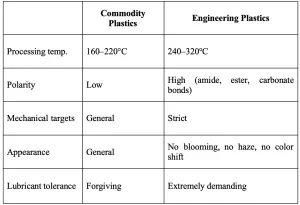

All six must be met — none can be skipped.
Montan wax, extracted from lignite, is built around C26–C32 long-chain wax esters — a molecular structure that happens to align precisely with all six engineering plastic requirements.

Six requirements, all met — this is why Montan wax has long been the benchmark.
Other Common Options
PETS — Balanced internal/external lubrication; good for PC, PBT
EBS (amide wax) — Strong external lubrication and mold release; PA, ABS
Maleic anhydride-grafted wax — High polarity; glass-fiber-filled systems
EAA wax — Combined lubrication and dispersion; high-filler formulations

Despite its performance, Montan wax has persistent limitations:
① Purity — Even after refining, residual resins, short-chain hydrocarbons, and pigments remain. These volatilize under high heat, generating odor, smoke, and accelerating mold deposit buildup.
② Batch inconsistency — Acid value, saponification value, and color can shift from batch to batch, forcing formulation engineers to constantly re-adjust recipes.
③ Supply chain vulnerability — Montan wax depends on specific lignite mining regions. Any disruption — at the mine, in logistics, or geopolitically — directly exposes customers to supply risk.
These three pain points are exactly what drove the development of synthetic polyester wax.
① Cleaner
Synthesized from pure alpha-olefin feedstocks with precisely controlled processes. Significantly lower low-molecular-weight impurity content means less smoke, slower mold deposit buildup, and cleaner part surfaces.
② More Consistent
Acid value, saponification value, and softening point are tightly controlled batch to batch — no formulation re-adjustment needed.
③ More Reliable
Production facilities operating in China and Vietnam, with expansion planned in Egypt and Mexico. No mining dependency. No single-source risk. No supply interruptions.
④ More Cost-Effective
Synthetic production avoids the mine–extract–refine cost chain of natural wax. Equivalent performance at a price significantly below imported Montan wax.
⑤ More Flexible — Fully Customizable
Natural Montan wax cannot be adjusted — its molecular structure is fixed by geology. Rallychem synthetic polyester wax is tunable to order:

One product platform. Compatible with PA6, PA66, PC, PBT, PU — and customizable for each.

Lubricant selection in engineering plastics is about balancing three things at once:
Processing efficiency — clean demolding, no sticking, no smoke
Product quality — no blooming, no defects, mechanical targets met
Long-term stability — consistent batches, reliable supply, minimal formulation adjustment
Rallychem synthetic polyester wax is engineered to deliver all three.
Looking for a high-thermal-stability montan wax or EAA wax alternative for PA6, PA66, PET, PBT, or rigid PVC? Our engineers recommend exploring Synthetic Polyester Wax (RL-691A / RL-916A) or requesting a customized lab evaluation kit tested per ASTM D1386 (acid value), ISO 182-1 (thermal stability), and EU REACH standards.
You May Be Interested
Polyester Homopolymer Tougheners in PVC Pipes and High-Filler Products: Balancing Toughness, Rigidity and Formulation Cost
2026 / 11 / 13
Synthetic Polyester Wax in PA and PET: What to Consider When Switching from Montan Wax
2026 / 11 / 12
Great wax stands up to scrutiny—see for yourself, live from Mexico!
2026 / 11 / 12
At the exhibition? RALLYCHEM is waiting for you at 6.1H15!
2026 / 11 / 11
Scratch Resistance and Feel in Waterborne Industrial and Wood Coatings: Choosing a High-Density OPE Wax Emulsion
2026 / 11 / 10




For Inquiries Please Call
Rallychem Will Be Happy To Assist You!
+86 13456396233





 English
 Español
 Français
 日本語
 한국어
 العربية
 فارسی
 Deutsch
 Italiano
 Tiếng Việt
 ไทย
 Русский
 Bahasa Indonesia
 Bahasa Melayu
 Türkçe


