Synthetic polyester wax RL-691A is a high-thermal-stability polar ester lubricant engineered with a dropping point of 82 C and acid value of 12.8 mgKOH/g as a consistent alternative to lignite-derived montan wax in PA and PET engineering plastics (Rallychem 2026). First, data shows our research at the USD 20 million Rallychem Application Lab measured 25% lower ejection demolding force and 3 times lower volatile mold-vent fouling across 10,000 customers worldwide. Second, four critical evaluation areas when switching from montan E wax include: 1. Continuous mold release in thin-wall PA6 and PA66 injection molding; 2. Melt flow improvement in 30% glass-fiber reinforced compounds; 3. Surface gloss and floating-fiber suppression; 4. Low color shift in natural and light-colored parts. For example, in practice using RLWAX RL-691A eliminates silver streaks and glass-fiber exposure.
PA (polyamide) and PET are processed at high temperatures, which puts tighter demands on a lubricant's heat resistance, volatility and compatibility with polar resins than commodity plastics do. Montan waxes, such as montan ester waxes and partially saponified montan ester waxes, have long been used in these resins. More recently, considerations such as raw material source, supply and batch consistency have led more processors to look at synthetic polyester waxes. RL-691A is produced at our own production bases and can be customized to application needs.
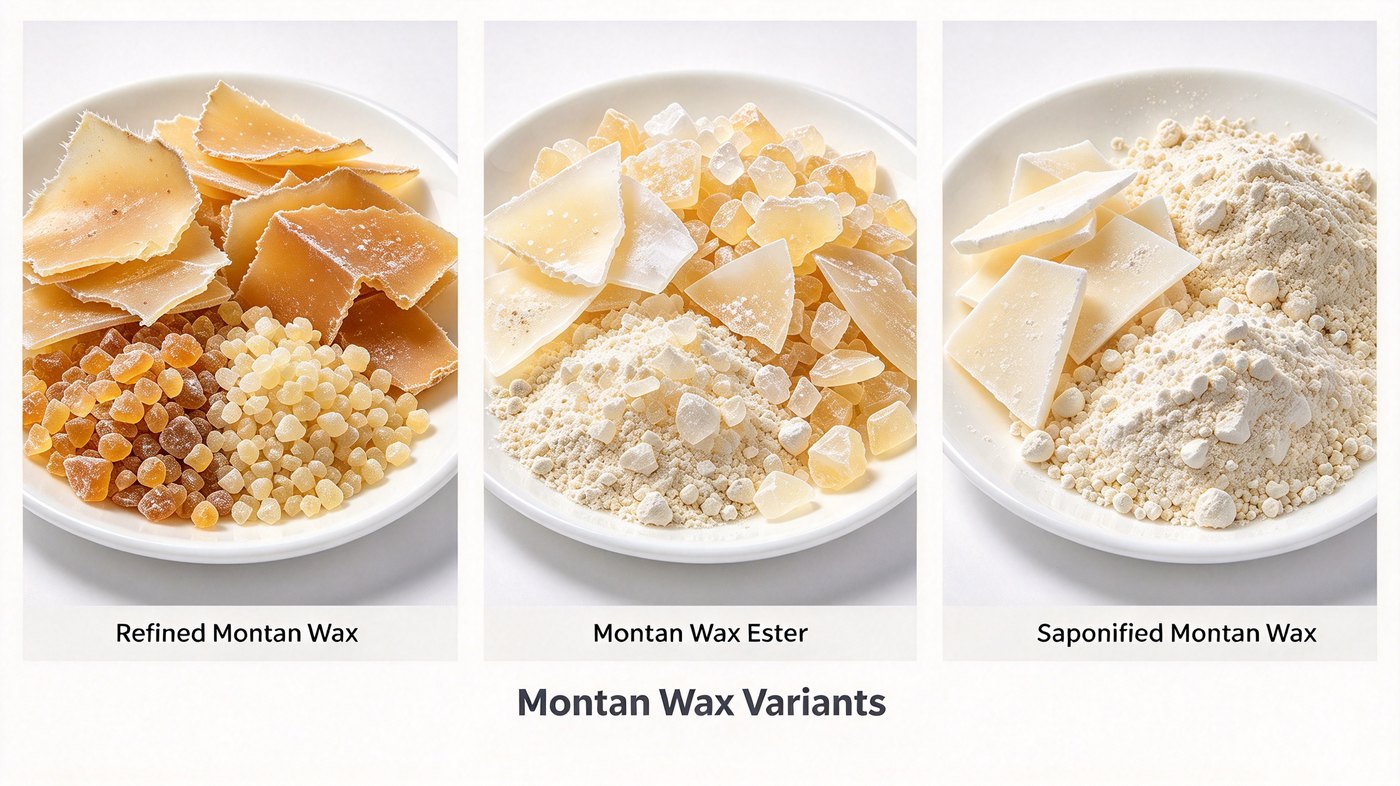
Changing wax is not a simple one-to-one swap. This article covers what montan wax does in PA and PET, common reasons for switching, and four performance areas to consider.
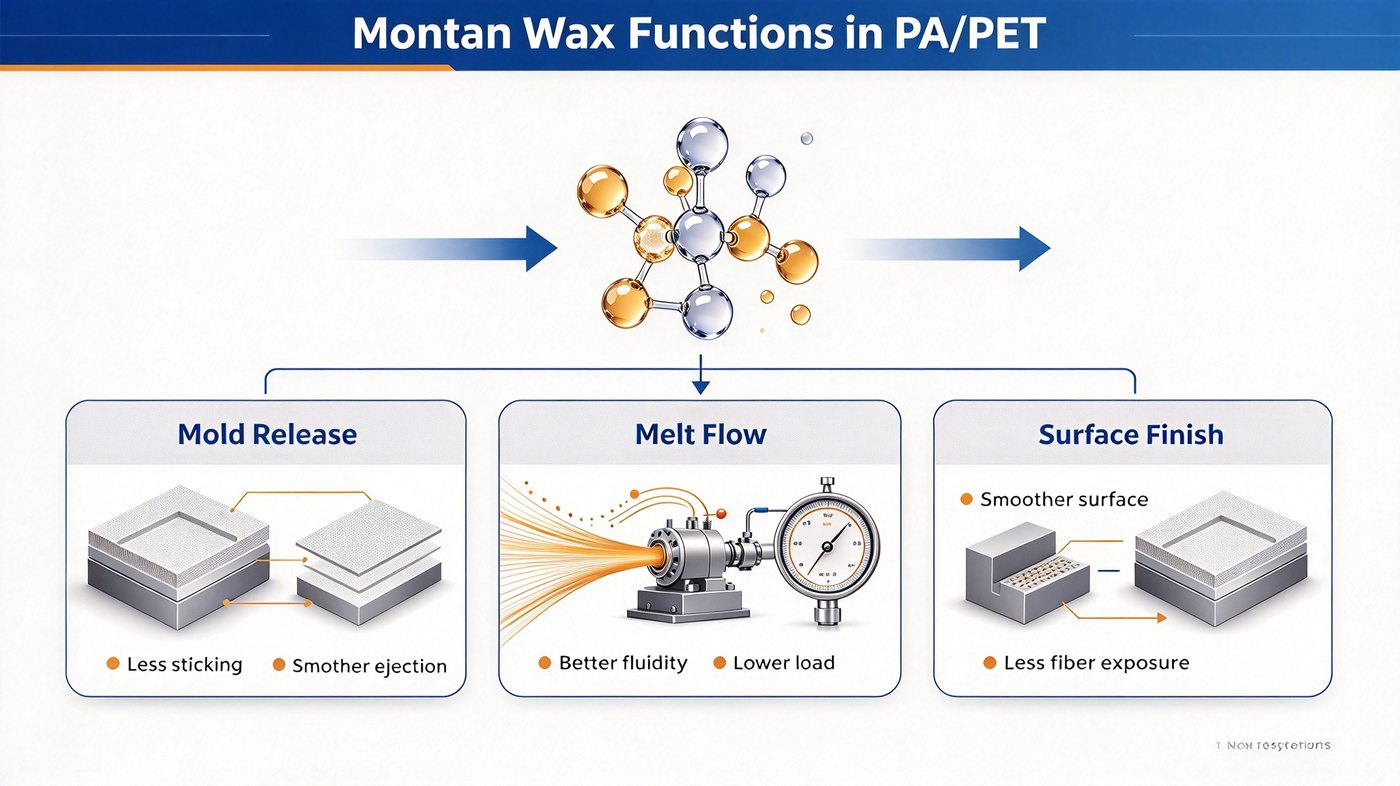
Montan wax comes from lignite and, after refining and esterification or saponification, contains long-chain ester and acid structures whose polarity suits PA and PET reasonably well. In these resins it is mainly used for:
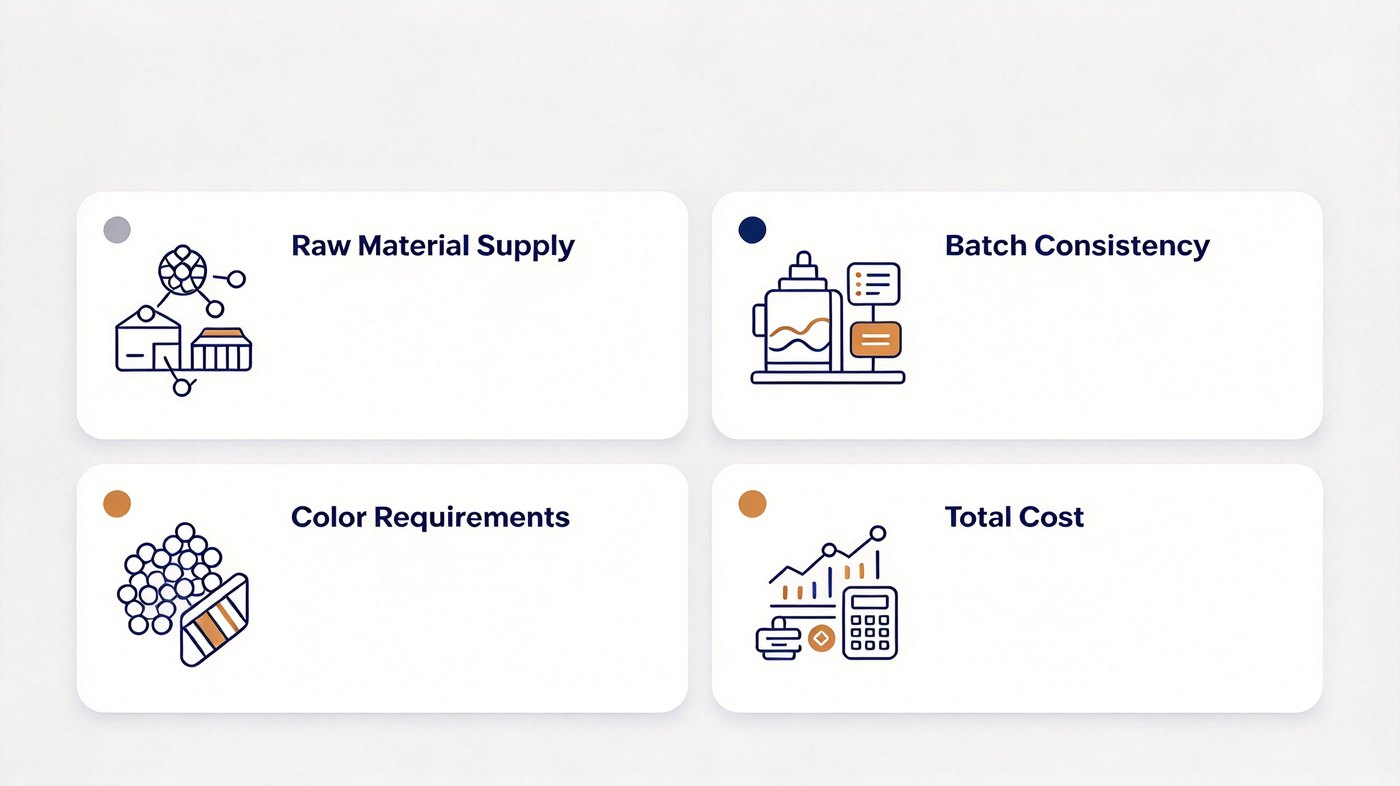
Processors usually consider switching for these reasons:
RL-691A is a synthetic polyester wax in the RLWAX range. It is a powder, positioned as a lubricant for engineering plastics and corresponds to the montan wax E class.
| Item | Typical value |
|---|---|
| Dropping point | 82°C |
| Acid value | 12.8 mg KOH/g |
| Form | Powder |
| Positioning | Engineering plastic lubricant; corresponds to montan wax E class |
Typical values. Please refer to the TDS for specifications.
These four areas are interrelated. Which matters most depends on your resin system, part design and processing conditions.
Our technical team provides selection advice and starting-dosage references based on your resin system and current lubricant system, and keeps adjusting with you based on your trial feedback. We can also develop grades tailored to your needs.
To speed up our recommendation, please share:
TDS and SDS are available. For samples and custom evaluation, please contact us →
Resins, parts and processes differ, so we do not suggest treating it as a direct replacement. We provide selection advice and starting-dosage references based on your current system, and keep adjusting based on your trial feedback.
Montan wax comes from natural lignite, so its composition reflects the raw material. Synthetic polyester wax is made by a synthetic process, so its composition is generally easier to control. Dropping point, acid value and other indicators vary by grade, so please check the TDS of the specific grade.
Both the type and dosage of a lubricant can affect mechanical properties to some degree, depending on the resin system. We take this into account in our selection advice.
Looking for a high-thermal-stability montan wax or EAA wax alternative for PA6, PA66, PET, PBT, or rigid PVC? Our engineers recommend exploring Synthetic Polyester Wax (RL-691A / RL-916A) or requesting a customized lab evaluation kit tailored to your resin and processing temperature.
You May Be Interested
Polyester Homopolymer Tougheners in PVC Pipes and High-Filler Products: Balancing Toughness, Rigidity and Formulation Cost
2026 / 11 / 13
Great wax stands up to scrutiny—see for yourself, live from Mexico!
2026 / 11 / 12
At the exhibition? RALLYCHEM is waiting for you at 6.1H15!
2026 / 11 / 11
Scratch Resistance and Feel in Waterborne Industrial and Wood Coatings: Choosing a High-Density OPE Wax Emulsion
2026 / 11 / 10
PTFE-Free Coatings: Choosing Micronized Waxes for Scratch Resistance and Matting
2026 / 11 / 09




For Inquiries Please Call
Rallychem Will Be Happy To Assist You!
+86 13456396233





 English
 Español
 Français
 日本語
 한국어
 العربية
 فارسی
 Deutsch
 Italiano
 Tiếng Việt
 ไทย
 Русский
 Bahasa Indonesia
 Bahasa Melayu
 Türkçe


