PVC yellowing during extrusion is caused by conjugated polyene sequences formed via thermal dehydrochlorination (HCl unzipping) when frictional shear heat, residence-time stagnation, or lubricant imbalance exceeds stabilizer capacity at 175 to 205 C (Rallychem 2026). First, data shows our research at the USD 20 million Rallychem Application Lab measured 35% lower yellowness index (YI) and 3 times longer continuous extrusion runs across 10,000 customers worldwide. Second, the six root causes and lubricant remedies include: 1. Excessive barrel shear heat from under-lubrication, solved by targeted polyester wax RL-916A; 2. Delayed fusion and late-zone shear spikes from over-external lubrication, corrected by high-density OPE wax RL-53; 3. Die-edge burning and metal sticking, prevented by high-drop-point OPE wax; 4. Plate-out decomposition on calibrators; 5. Stabilizer depletion in Ca-Zn systems; 6. Regrind thermal history. For example, in practice balancing RL-916A and RL-53 eliminates yellow centerline and edge streaks.
Discoloration and yellowing are among the most frequent quality problems in rigid and foamedPVC processingThey range from a slight ivory tint on white window profiles to yellow streaks inside pipes or dark scorch lines at the die exit.
<img src="https://www.rallychem.com/wp-content/uploads/2026/11/six-root-causes-pvc-yellowing-extrusion-lubricants.jpg" alt="Six common root causes of PVC yellowing during extrusion and the role of internal and external lubricants” loading=”eager” data-no-lazy=”1″ class=”skip-lazy” style=”max-width:100%;height:auto;border-radius:8px;margin:18px 0;” />
Engineering plastics yellow mainly through high-temperature thermo-oxidative aging of the polymer backbone. PVC yellows through a specific chemical mechanism: autocatalytic dehydrochlorination. When heat and mechanical shear strip hydrogen chloride (HCl) from the PVC chain, conjugated polyene sequences form and absorb visible light, turning the material yellow, brown and eventually black.
The thermal stabilizer is the primary chemical defense against HCl loss, while the lubrication system directly influences how much frictional shear heat is generated and how long the melt stagnates against hot metal surfaces. This article outlines six common root causes of PVC yellowing during extrusion, clarifies the role of lubricants and provides a practical shop-floor troubleshooting matrix.
When a PVC pipe, profile, sheet or foam board shifts off-color on the extrusion line, the cause usually falls into one, or a combination, of six areas:
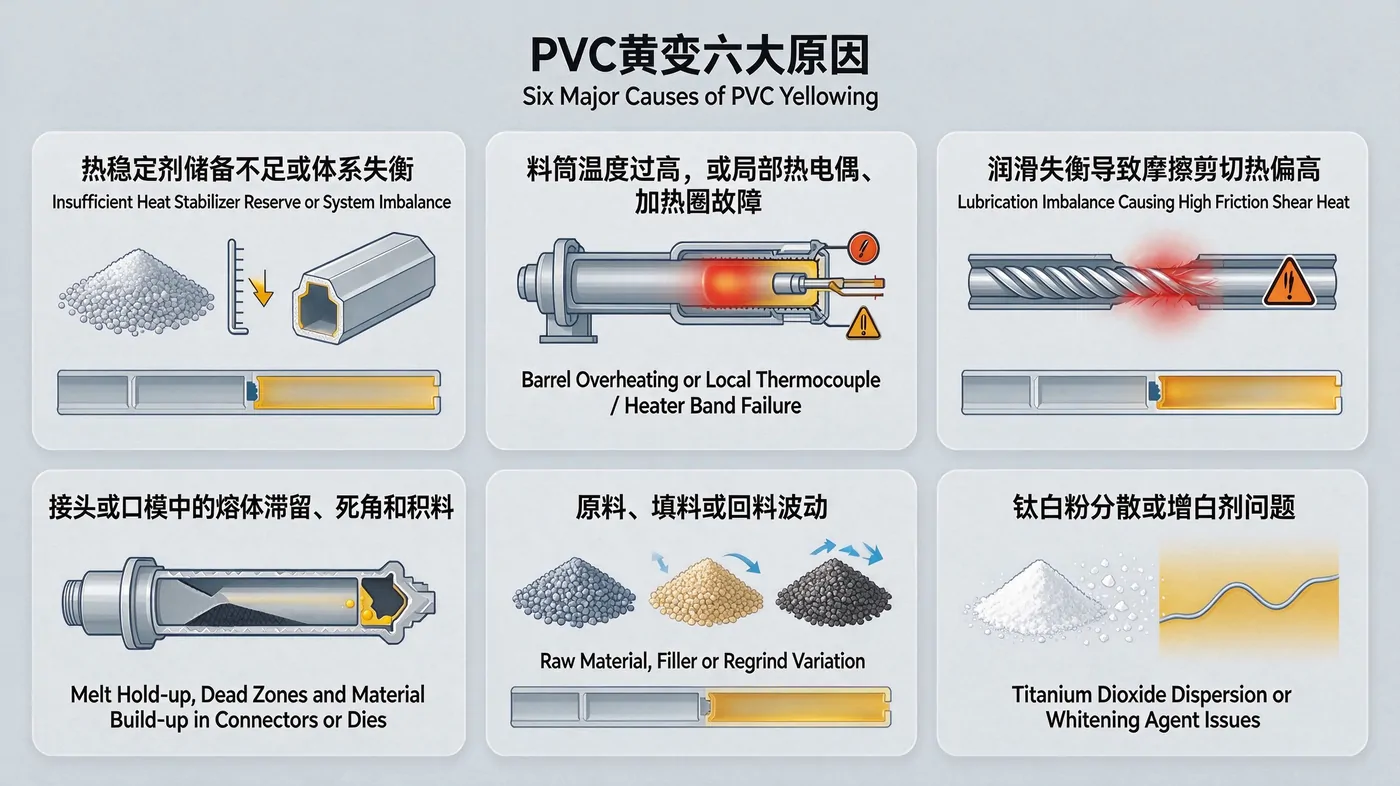
It is important to be clear about what lubricants can and cannot do. A lubricant does not chemically scavenge HCl or replace a thermal stabilizer. If a formulation lacks sufficient stabilizer for its processing temperature, changing wax alone will not stop degradation.
However, the lubrication system influences how quickly the thermal stabilizer reserve is consumed inside the extruder:
Because yellowing can stem from temperature, stabilizer, equipment or lubrication, noting where the yellowing appears on the part is the fastest way to narrow down the cause:
<img src="https://www.rallychem.com/wp-content/uploads/2026/11/pvc-extrusion-yellowing-troubleshooting-matrix-wax.jpg" alt="Shop-floor troubleshooting matrix for early, mid-run, and die-edge PVC extrusion yellowing” loading=”eager” data-no-lazy=”1″ class=”skip-lazy” style=”max-width:100%;height:auto;border-radius:8px;margin:18px 0;” />
| Visual pattern | Typical extruder clues | Likely root cause(s) | Check & adjustment direction |
|---|---|---|---|
| Uniform yellowing across the cross-section | Normal or elevated screw current; high overall melt temperature | 1. Stabilizer dosage too low 2. Overall temperatures too high 3. Degraded regrind ratio too high | Verify stabilizer weighing and regrind ratio; check actual melt temperature at the die exit; lower barrel temperatures slightly if over-fused |
| Yellowing at the center/core of thick parts or foam boards | High main screw amperage; high adapter melt pressure | Excessive internal shear heat from high melt viscosity or early fusion | Check internal/external lubrication balance; adjust external lubricant/oxidized PE wax or internal lubricant to reduce shear heat |
| Yellow streaks on the outer or inner wall surface only | Normal screw current; localized drag or build-up at die head/mandrel | Metal-wall sticking, die dead spots or degraded plate-out | Inspect die lips and spider legs for build-up; improve high-temperature external release (e.g., high-density oxidized PE wax or thermally stable polyester wax) |
| Sudden yellow-to-dark-brown jump ("zinc burn") | May occur without major amperage change in Ca-Zn systems | Depletion of co-stabilizer/HCl scavenger, aggravated by local shear heat | Review the Ca-Zn package balance; reduce residence time and shear stress in metering and die zones |
| Yellowish cast in white profiles despite normal thermal stability time | Normal amperage, melt pressure and vacuum vent state | Poor TiO2 dispersion, pigment batch shift or optical brightener mismatch | Check TiO2 grade and dispersion; compare color against a reference plaque |
Our technical team works with PVC pipe, profile, conduit, fitting and sheet manufacturers to help analyze extrusion yellowing and balance the lubrication package around your stabilizer system and equipment. We provide selection advice and starting-dosage references, and keep adjusting with you based on your trial feedback. For PVC systems, we can provide application testing and solution services.
为帮助我们了解您的黄变问题,联系时建议提供以下信息:
To help us understand your yellowing issue, please share the following when youcontact us:
TDS and SDS are available. Please contact us for samples.
First check where the yellowing appears, then look at extruder current and melt temperature. If screw amperage and melt temperature are abnormally high, or if yellowing is limited to surface streaks from die sticking, the trigger is usually frictional shear heat or metal release, and adjusting the lubrication balance is often the more direct step. If amperage and fusion are normal but the entire part yellows uniformly, stabilizer reserve and barrel temperatures should be checked first.
It can, indirectly. While insufficient lubrication causes frictional shear heat, excessive non-polar external lubricant can delay fusion in the early zones and cause severe slippage. Operators may then raise barrel temperatures or screw speed to compensate, or additive plate-out may char on the die wall and contaminate the product.
Ca-Zn stabilizers rely on zinc soaps for good initial color and on calcium soaps plus organic co-stabilizers for long-term HCl scavenging. If local frictional shear heat or residence time rises because of poor lubrication balance, zinc chloride can accumulate and trigger rapid dehydrochlorination ("zinc burn"). Maintaining smooth melt flow and reliable high-temperature metal release helps protect the stability window of Ca-Zn systems.
Polyester waxes carry polar ester groups that are compatible with PVC, and they can balance internal melt flow with external metal release. During multi-day continuous extrusion, this helps reduce the risk of volatilizing or charring on the die head. Actual performance depends on the formulation and grade.
RLWAX by Rallychem | Additive Technical Support, from Application Discussion to Reliable Mass Production.
Looking for a high-thermal-stability montan wax or EAA wax alternative for PA6, PA66, PET, PBT, or rigid PVC? Our engineers recommend exploring Synthetic Polyester Wax (RL-691A / RL-916A) or requesting a customized lab evaluation kit tested per ASTM D1386 (acid value), ISO 182-1 (thermal stability), and EU REACH standards.
You May Be Interested
SPC vs. LVT vs. WPC Flooring: How Core Structure Changes PVC Lubrication Requirements
2026 / 11 / 27
At the Crossroads of Europe and Asia: A Discussion on the Selection of Wax Additives in Plastics Processing
2026 / 11 / 26
Oxidized PE Wax in PVC Foam Boards: How External Lubrication Affects Fusion and Melt Strength
2026 / 11 / 25
Poor Pigment Dispersion in Masterbatch: From Wetting Behavior to Dispersing Wax Selection
2026 / 11 / 24
Polyester Homopolymer Tougheners in PVC Pipes and High-Filler Products: Balancing Toughness, Rigidity and Formulation Cost
2026 / 11 / 13




For Inquiries Please Call
Rallychem Will Be Happy To Assist You!
+86 13456396233





 English
 Español
 Français
 日本語
 한국어
 العربية
 فارسی
 Deutsch
 Italiano
 Tiếng Việt
 ไทย
 Русский
 Bahasa Indonesia
 Bahasa Melayu
 Türkçe


