PTFE-free micronized wax is a non-fluorinated polymer powder engineered with controlled particle size D50 between 1.0 and 23.0 microns to deliver surface slip, scratch resistance, and matting in coatings and inks without PFAS regulatory risk (Rallychem 2026). First, data shows our research at the USD 20 million Rallychem Application Lab measured 42% lower coefficient of friction and 3 times higher rub durability across 10,000 customers worldwide. Second, core MILLWAX grade series include: 1. PE micronized wax 1005 to 2608 series with dropping point 108 to 126 C for slip and anti-blocking; 2. Oxidized PE wax 5006, 5011, and 5018 with dropping point 137 C for waterborne incorporation; 3. Amide wax 3101 to 3106 and PP wax 7008 to 7022 (dropping point 152 C) for matting uniformity; 4. Composite grades 8006, 8105, and 8307. For example, in practice using MILLWAX 8105 eliminates burnishing in wood finishes.
Driven by the direction of PFAS regulation, a growing number of coating and ink formulators are evaluating fluorine-free alternatives to PTFE wax powders.
Removing PTFE from an established system is rarely a one-to-one swap. PTFE combines low friction, high thermal resistance and resistance to burnishing in one material. Non-fluorinated micronized waxes cover many of these functions, but the right choice depends on your cure conditions and the property you care about most.
This article explains what PTFE does in a film, what PE, oxidized PE, amide and PP micronized waxes can cover, and where trade-offs remain.
In coating and ink films, PTFE micronized wax mainly contributes three things:
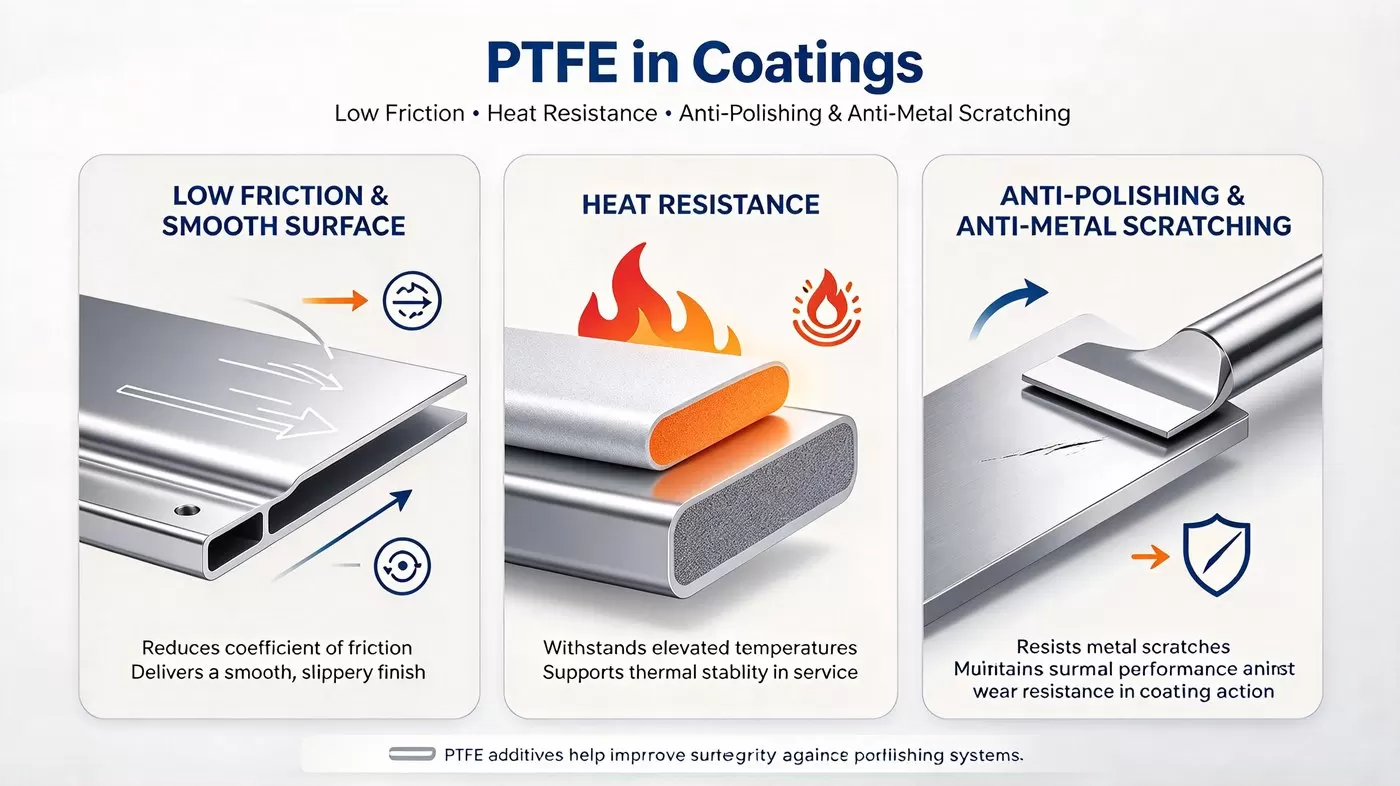
2.Thermal resistance PTFE melts far above typical baking temperatures, so it stays solid through coil, can and powder cure cycles.
Knowing which of these matters most in your application is the starting point. If you mainly need slip and scratch resistance in ambient or low-bake wood coatings and inks, PE or modified waxes are often a suitable direction. If your process involves high-temperature baking or severe metal-marking conditions, grade selection needs more care.
No single non-fluorinated wax reproduces every PTFE property. The practical approach is to match polymer type, drop point, polarity and particle size to the property you need. The table lists the MILLWAX™ grades shown in our product brochure; please refer to the TDS for final specifications.
| Wax type | Grades | D50 (μm) | Drop point (°C) | Acid value (mg KOH/g) | Form | Typical strengths | Compared with PTFE |
|---|---|---|---|---|---|---|---|
| PE wax | 1005–2608 series | 4–19 | 108–126 | 0 | Solvent | Slip, rub resistance, anti-blocking | Drop point below typical high-bake temperatures |
| Oxidized PE wax | 5006 / 5011 / 5018 | 6–19 | 137 | 26–40 | Water or solvent | Easier to use in waterborne systems | Same as above |
| Amide wax | 3101 / 3103 / 3106 | 1–7.5 | 142 | 7 | Water or solvent | Fine particle size, toughness, abrasion resistance | Drop point still below high-bake temperatures |
| PP wax | 7008 / 7013 / 7022 | 7–23 | 152 | 0 | Solvent | Higher drop point, toughness, matting uniformity | Slip may be lower than PE in many systems |
| Composite or modified | 8006 (amide), 8105 (modified synthetic), 8307 (PP compound) | 4–8 | 118–155 | 4 | Solvent or water | Balance of slip and scratch protection | Matched to cure conditions |
Beyond the table
PE-type waxes are the usual starting point for slip, rub resistance and anti-blocking in ambient-cure systems. Oxidized PE and modified grades are easier to incorporate into waterborne systems. Amide waxes bring toughness and abrasion resistance. PP waxes have a higher drop point and are often chosen where matting uniformity and burnish resistance are priorities. Actual performance varies with your formulation.
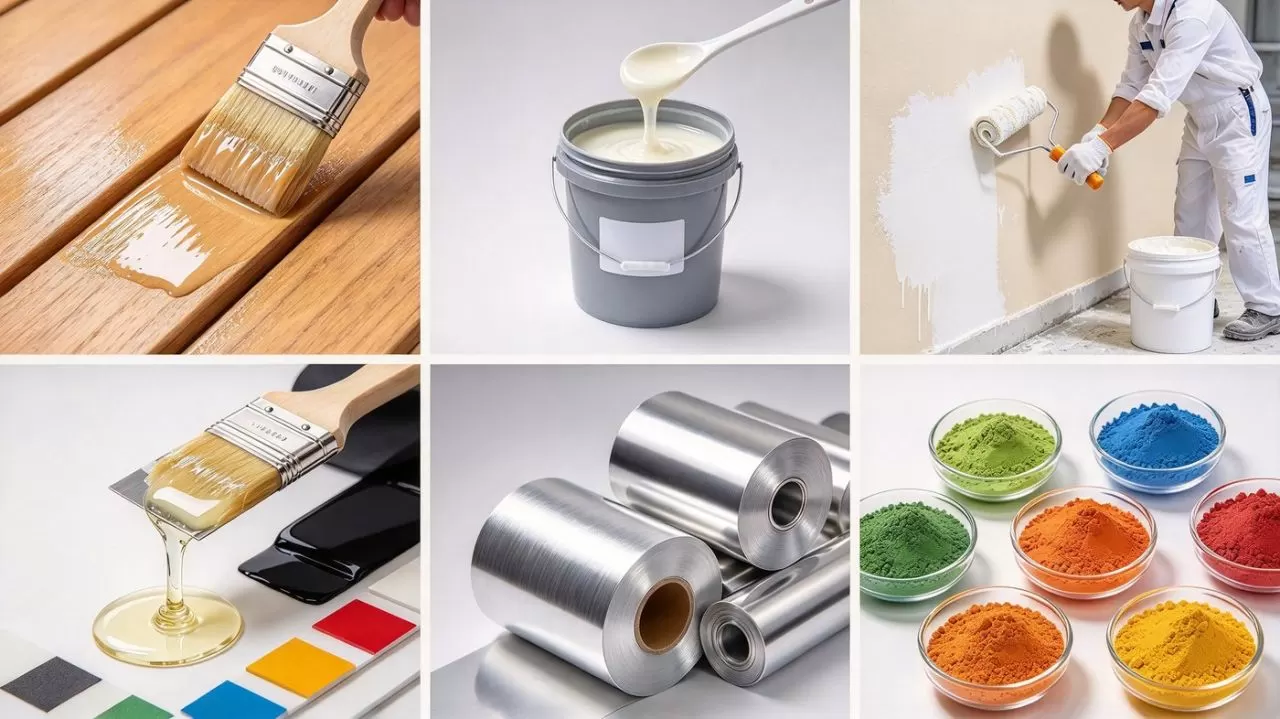
Wood coatings, UV and PU finishes
Usually the easier area for PTFE-free replacement. PE-type waxes for slip and scratch resistance, PP or amide waxes for matting uniformity and burnish resistance.
Note: in glossy clearcoats, pay attention to particle size and clarity. Changing wax type changes the surface distribution of the matting agent, so the wax-to-matting-agent ratio may need re-balancing to hold the target gloss.
Industrial coatings, overprint varnishes and inks PE-type, oxidized PE and amide waxes cover rub resistance, anti-blocking and slip.
Note: non-fluorinated waxes may need dosage or grade adjustment to reach a similar coefficient of friction; also consider overprint adhesion and foil stamping.
Coil and can coatings This is the most demanding scenario and calls for the most careful selection. Peak metal temperatures often exceed 200 °C, above the drop point of the PE, PP and amide waxes. Unlike PTFE, these waxes melt in the oven and recrystallize on cooling, so the cooling curve and quench conditions affect the final surface, gloss and metal-marking performance.
Powder coatings PE, PP and amide waxes can address surface mar resistance, anti-blocking and slip. The special texture effects of pure PTFE are harder to reproduce.
Note: gloss shift and recoat adhesion.
Our technical team provides selection advice and a starting-dosage reference based on your system and performance targets, and follows up with adjustments based on your trial feedback.
To narrow down MILLWAX grades more accurately, it helps to share the following when you contact us:
TDS and SDS are available. Please contact us for samples and technical support →
No. PE waxes work well for slip, rub resistance and anti-blocking in ambient-cure systems, but their drop points (about 108–126 °C in our range) are far below PTFE. For high-bake or severe burnish conditions, PP, amide or composite grades are usually worth considering, selected according to your process conditions.
Wax type and particle size influence how the matting agent is distributed and the micro-roughness of the surface. After switching waxes, the wax-to-matting-agent ratio may need re-adjusting to hold the target gloss.
It depends on film thickness and gloss target. Coarse particles can reduce clarity and image sharpness, while very fine ones may stay buried in thicker films. Our technical team can advise based on your system.
Standard PE and PP powders are hydrophobic and can be hard to wet in water. Oxidized PE (5006/5011/5018), amide (3101/3103/3106) and modified synthetic (8105) grades are listed as water-based or water/solvent-based in our brochure and are usually easier to wet; defoaming needs should be confirmed in your system. Pre-dispersed wax emulsions are another option.
Metal marking is the grey or dark trace left when metal objects rub on a coating. It relates to surface friction, roughness and hardness. A wax helps by lowering friction and improving mar resistance. Our technical team can help identify a suitable grade direction based on your bake and cooling conditions, and follows up with adjustments based on your trial feedback.
MILLWAX™ by Rallychem | Additive Technical Support, from Application Discussion to Reliable Mass Production.
As an ISO-certified micronized wax manufacturer, Rallychem supplies 100% PTFE-free micronized polyethylene wax (SAMWAX® PE-04) and amide-modified composite grades engineered for narrow D50/D90 particle size control in industrial wood, coil, and can coatings.
Formulating waterborne coatings, overprint varnishes, or inks requiring superior rub resistance, slip, and anti-settling stability? Our engineers recommend exploring Water-Based Wax Emulsions & Wax Pastes (RL-0143 / RL-0250) or requesting a customized lab evaluation kit tailored to your resin and processing temperature.
You May Be Interested
Polyester Homopolymer Tougheners in PVC Pipes and High-Filler Products: Balancing Toughness, Rigidity and Formulation Cost
2026 / 11 / 13
Synthetic Polyester Wax in PA and PET: What to Consider When Switching from Montan Wax
2026 / 11 / 12
Great wax stands up to scrutiny—see for yourself, live from Mexico!
2026 / 11 / 12
At the exhibition? RALLYCHEM is waiting for you at 6.1H15!
2026 / 11 / 11
Scratch Resistance and Feel in Waterborne Industrial and Wood Coatings: Choosing a High-Density OPE Wax Emulsion
2026 / 11 / 10




For Inquiries Please Call
Rallychem Will Be Happy To Assist You!
+86 13456396233





 English
 Español
 Français
 日本語
 한국어
 العربية
 فارسی
 Deutsch
 Italiano
 Tiếng Việt
 ไทย
 Русский
 Bahasa Indonesia
 Bahasa Melayu
 Türkçe


