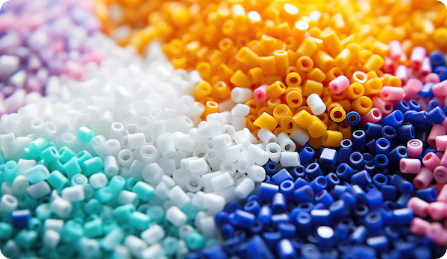
PVC, PE, and PP are the three most widely used commodity plastics in the world. PVC (polyvinyl chloride) is a rigid or flexible chlorine-containing polymer best known for pipes, profiles, and cable insulation. PE (polyethylene) is a lightweight, chemically resistant polyolefin used in films, bags, and bottles. PP (polypropylene) is a stiffer, more heat-resistant polyolefin used in food containers, automotive parts, and fibers. Each material has a distinct balance of cost, processability, and performance, so the right choice depends on the application rather than on any single property.
Polyvinyl chloride (PVC) is one of the earliest industrialized plastics and remains a workhorse in construction and infrastructure. Its excellent plasticity in processing, combined with low raw material cost, makes it the default choice for pipes, profiles, building materials, and wire and cable sheathing.
PVC film also shrinks evenly when heated, which is why it is widely used for shrink labels on boxes and bottles. Because of its chlorine content, PVC is inherently flame retardant: it self-extinguishes once the ignition source is removed, and it releases an acidic odor when burned. Because PVC is heat-sensitive, successful processing depends heavily on the additive package. See our PVC processing solutions for stabilizer and lubricant systems designed for pipe, profile, and sheet extrusion.
Key characteristics of PVC:

Polyethylene (PE) is the most widely used plastic in industry and daily life. It is generally divided into high-density polyethylene (HDPE) and low-density polyethylene (LDPE).
HDPE has a higher melting point, greater hardness, and better resistance to corrosive liquids than LDPE. PE as a whole offers excellent acid and alkali resistance, which is why most translucent or opaque plastic bottles for detergents, shampoos, lotions, edible oils, and agrochemicals are made from HDPE.
How to identify PE: mostly opaque, with a wax-like feel; PE bags make a rustling sound when rubbed.
HDPE is produced by low-pressure gas-phase or liquid-phase processes, with a density of 0.950–0.965 g/cm³. It is a rigid thermoplastic, preferred for blow-molded hollow products, and it competes directly with PVC and metal in the pipe market.
LDPE is produced by a high-temperature, high-pressure process, with a density of 0.915–0.930 g/cm³. It is a semi-rigid thermoplastic. LDPE film frequently competes with PVC and PP in shrink and stretch packaging applications. Most everyday plastic bags and films are made from LDPE, and uncolored LDPE containers are usually translucent, such as squeeze bottles and flexible film boxes.
Polypropylene (polypropylene, PP) is a polymerization of propylene, and polyethylene similar to have greater mechanical strength and higher melting point (about 165 ℃), the polyethylene in a hydrogen atom replaced by methyl (methyl, CH3).
Advantages .
Lightweight, chemical resistant, heat resistant
Disadvantages .
Poor impact resistance at low temperatures
Difficult to be painted or adhered to by adhesives
Molded surfaces reinforced with glass fibers are not smooth
Polypropylene offers a balance of properties and price that most thermoplastics cannot. Polypropylene is easy to mold and has excellent chemical and mechanical resistance.
Polypropylene is used in the automotive industry, household appliances, plastic rope, carpeting, shoe heels, as well as in kitchen and bathroom fixtures, tubing; transparent film for packaging and wrapping paper for fresh food. Its low flammability and breathability make it highly suitable for sportswear, and some high-quality horns are made from polypropylene, especially automobile horns; its high strength makes it suitable for use in the manufacture of automobile bumpers.
PP is more rigid and heat-resistant than PE, often used in food packaging, with a pinch there will be a crunch crunch crunch crunch sound, in the disposable lunch boxes, milk tea cups a large number of applications.
Q: Which is stronger, PVC, PE, or PP? Rigid PVC has the highest tensile strength and stiffness of the three. PP is stronger than PE but less stiff than rigid PVC. Strength rankings change for flexible formulations, so always compare specific grades.
Q: Which is the cheapest? All three are low-cost commodity plastics. PVC and PE are usually at the low end; PP is slightly higher but still economical. Real cost differences come from formulations and processing, not the base resin.
Q: Which plastic is best for pipes? PVC dominates pressure and drainage pipes because of its rigidity and cost. HDPE is preferred for flexible, corrosion-resistant water and gas pipes. PP is used where higher temperature resistance is needed, such as hot-water systems.
Q: Can these three plastics be recycled together? No. PVC, PE, and PP have different melting points and chemical structures, and mixing them in recycling streams degrades material quality. They must be sorted and recycled separately.
Understanding the difference between PVC, PE, and PP is the first step; getting stable processing performance is the next. If you are formulating or extruding PVC products, our technical team can help you select the right stabilizer and lubricant system — contact Rallychem or explore our PVC processing solutions.
You May Be Interested
The “Stumbling Block” in Continuous PVC Production: Persistent White Powder
2026 / 09 / 30
A Supplier Looking at Suppliers: Where Is the Real Difference Between CPVC Lubricant Suppliers?
2026 / 09 / 29
CPVC Resin Switching: Why a Lower-Cost Resin Can Reduce Extrusion Output
2026 / 09 / 28
Save Around 20% Per Ton — While Keeping Pipe Performance on Spec
2026 / 09 / 25
CPVC Pipe Flow Marks and Scorching After Resin Replacement: How to Troubleshoot Extrusion Problems?
2026 / 09 / 23




For Inquiries Please Call
Rallychem Will Be Happy To Assist You!
+86 13456396233





 English
  Español
  Français
  日本語
日本語  한국어
한국어  العربية
  فارسی
فارسی  Deutsch
  Italiano
  Tiếng Việt
  ไทย
ไทย  Русский
  Bahasa Indonesia
  Bahasa Melayu
  Türkçe


