As cost reduction and efficiency improvement continue to be key priorities for CPVC pipe manufacturers, how to reduce production costs while maintaining stable production capacity and product quality has become an issue that many manufacturers must address.
In
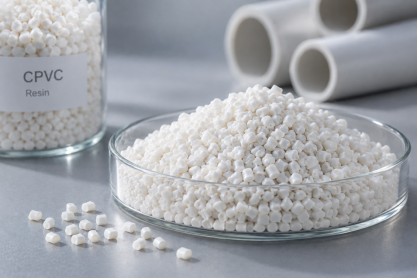
CPVC pipe production, resin typically accounts for a relatively high proportion of the overall production cost. Therefore, when manufacturers seek to further optimize costs, looking for a more competitively priced resin supplier or an alternative resin often becomes one of the most direct and common approaches to cost reduction.
However, switching resin is not simply a matter of replacing a higher-priced resin with a lower-priced one.
For CPVC extrusion, resin is not only the base raw material that accounts for the largest proportion of the formulation, but also the foundation of the entire processing system.
The existing stabilizer system, internal and external lubricants, impact modifiers, and processing conditions are often established around the characteristics of the original resin through long-term production validation.
Therefore, when the resin changes, the actual processing behavior may also change, even when the basic specifications of the new and original resins appear to be very similar.
A Real Case: What Happened When an Indian Pipe Manufacturer Switched from Imported Resin to Local Resin?
Customer A is an Indian CPVC pipe manufacturer that had been using imported resin for a long period of time. To reduce raw material costs and improve supply chain independence, the company decided to switch to locally produced Indian resin.
At the beginning, the specifications of the new local resin appeared to be basically consistent with those of the original resin.
Therefore, the initial assumption was that the original formulation and processing conditions should still be applicable.
However, after the switch, the customer encountered a series of unexpected problems:
-
The original formulation system was no longer compatible with the characteristics of the new resin. Under high-speed extrusion, thermal stability dropped significantly. Production speed decreased instead of increasing, while flow marks and scorching appeared on the pipe surface. Low-temperature impact tests also failed repeatedly. This resulted in losses of both raw materials and processing costs, while affecting the quality reputation and market competitiveness of the finished products.
-
Under the original equipment and production conditions, output could no longer be maintained at the previous level. The production gap reached 30 kg/h, with an estimated monthly production loss of approximately 16.5 tons.
The customer therefore tried to solve the problem by adjusting processing conditions, but became trapped in a cycle of repeated performance adjustments:
Performance deterioration → Adjust temperature → Adjust screw speed → Adjust production conditions → Retest → Still unstable → Continue adjusting
After more than one year and multiple rounds of adjustments by the technical team, the problem remained unresolved, while raw material waste and time costs continued to accumulate. What was originally intended as a cost-reduction decision through local resin sourcing instead left the company caught in a difficult situation due to processing compatibility issues—with neither moving forward nor going back being an easy option.
Based on This Case, We First Need to Establish Two Key Understandings and Clarify Two “Whys”
1. Why can changing one resin affect the entire CPVC processing system?
This is also the key to understanding the problem.
CPVC pipe production is not simply:
Resin + additives → Extrusion
In practice, resin is the foundation of the entire processing system.
The stabilizer, internal lubricant, external lubricant, impact modifier, and other components need to be balanced around the processing characteristics of the resin.
It can be understood as:
Resin characteristics → Plasticization and melt behavior → Lubrication and stabilization system → Processing window → Final pipe performance
Therefore, a CPVC formulation that has been running stably is not a completely independent fixed formula that is unaffected by the resin.
It is actually developed and validated over a long period under a specific combination of:
Specific resin + specific formulation + specific equipment + specific processing conditions
Therefore:
Changing the resin does not simply mean changing one raw material. It actually changes the foundation of the entire system.
2. Why can production results still be different when the new and original resins appear to be very similar?
This is also one of the aspects of resin switching that is most easily underestimated.
When selecting an alternative resin, many manufacturers first compare the TDS. If the K-value, chlorine content, and other major specifications are similar, they may assume that the two resins can be directly substituted.
However, during actual processing, the processing characteristics of the resin also need to be considered.
For example:
K-value
Changes in K-value may affect melt viscosity, plasticization behavior, and melt flow characteristics.
This means that the original temperature, screw speed, and lubrication conditions may no longer be at their optimal levels.
Particle size and particle size distribution
Changes in particle size may affect material conveying, compaction, heating, and plasticization uniformity.
These differences may ultimately appear as changes in melt condition, surface quality, and even impact performance.
Resin composition and other key characteristics
Different sources of CPVC resin may have differences in processing behavior even when their basic specifications are similar.
These differences may ultimately be reflected in:
plasticization, production output, extrusion stability, Vicat softening temperature, low-temperature impact performance, and pipe appearance.
Therefore, determining whether a resin can be directly substituted cannot be based only on:
“Are the numbers on the TDS similar?”
It is also necessary to consider:
“Does the resin perform the same way after entering the existing formulation and equipment?”
So, How Did Rallychem Solve the Problem?
After the customer had spent more than one year trying to resolve the production, appearance, and performance problems following the resin switch, we did not start directly from the question of “what additive should be added.”
Instead, we first conducted a comprehensive analysis of the changes between the original imported resin and the local resin, the customer’s existing formulation, and the processing conditions, and analyzed the root cause of the failure of the original formulation system after the resin switch.
We then focused the problem further on one key point:
The change in the processing characteristics of the new resin affected the original lubrication balance and plasticization behavior.
This also explained why the customer had been unable to solve both problems at the same time—reduced output + failed low-temperature impact performance—despite spending a long time adjusting equipment parameters.
Equipment parameters can change processing conditions. However, if the compatibility relationship between the resin and the original formulation has already changed, simply adjusting equipment parameters may not be enough to restore the original balance.
Through a combination of laboratory testing, remote diagnosis, and on-site production trials, we gradually corrected the system and ultimately achieved results that exceeded the customer’s expectations.
The process can be summarized in five steps:
1. Identify the root cause
We compared the processing behavior before and after the switch from imported resin to local resin, and analyzed the changes in compatibility between the original lubrication and impact-modification system and the new resin, determining that the original formulation had become unbalanced under the new resin conditions.
2. Redesign the formulation
Based on the identified issues, we restructured the original formulation and developed Formulation 0#, which was then tested by the customer’s laboratory on a small scale and initially met the required product performance.
3. Continuously refine the formulation based on laboratory results
During the laboratory trials, we found that the Vicat softening temperature still did not meet the required level.
We did not stop at the laboratory data. Instead, we actively used vacuum-port production videos and remote communication to observe the actual processing condition and further adjusted the formulation to develop Formulation 1#, increasing the Vicat softening temperature from 105°C to 112°C.
4. Move from laboratory testing to production-line trials
To solve the output problem, our technical personnel went directly to the customer’s factory and conducted on-site trials on the twin-screw production line.
At the same time, we observed the actual material condition at the vacuum port, screw speed, barrel temperatures, and other production parameters, combining formulation adjustments with the actual equipment and processing conditions to solve the problem.
5. Validate the solution through final production results
The final results were:
-
Production speed increased from 270 kg/h to 300 kg/h, stably reaching the target, representing an increase of approximately 11.1%
-
Appearance problems were resolved, with no flow marks or scorching
-
Low-temperature impact performance met the requirements
-
Vicat softening temperature increased from 105°C to 112°C, stably meeting the required level
After Switching to a New Resin, How Should the Original Lubrication and Plasticization Balance Be Re-established?
What truly changes after switching resin may be more than just the resin itself.
When CPVC manufacturers encounter problems after changing resin, their first reaction is often:
“This resin is not good.”
However, the actual situation may be more complicated.
The new resin may not necessarily be unusable, and the original formulation may not necessarily be problematic.
What may have actually changed is:
The processing balance originally established for the old resin is no longer the optimal balance for the new resin.
You can start by answering three questions:
01 | What exactly has changed between the new and original resins?
Compare:
K-value, particle size/particle size distribution, chlorine content, and other key processing-related characteristics.
02 | Have these changes been transferred into the production process?
Observe:
plasticization, melt condition, vacuum-port condition, production output, and pipe appearance.
03 | Is the original formulation and processing setup still suitable for the new resin?
If you are evaluating a new CPVC resin supplier, or have already completed a resin switch but are experiencing performance or output problems, there is no need to make major changes to the formulation immediately.
You can first prepare:
① TDS of the original and new resins
② Current CPVC formulation
③ Equipment and key processing conditions
④ Changes in production output before and after the resin switch
⑤ Vicat and low-temperature impact test results
⑥ A video of the actual production process
Combining this information can usually help identify the direction of the problem more quickly than analyzing a single specification in isolation.
If the problem can be solved through processing adjustments, the processing window should be optimized first.
If simply adjusting equipment parameters still cannot restore performance, it is then necessary to reassess the compatibility between the new resin and the internal and external lubrication balance, stabilizer system, impact modification system, and other additives.
Of course, we welcome you to share the TDS of the original and new resins, your current formulation, production-site video, and the actual problems you are experiencing with us.
Let our expertise translate into technical support that creates real value for your production.
Don’t let a single resin switch turn into more than a year of repeated trial and error.











 English
  Español
  Français
  日本語
日本語  한국어
한국어  العربية
  فارسی
فارسی  Deutsch
  Italiano
  Tiếng Việt
  ไทย
ไทย  Русский
  Bahasa Indonesia
  Bahasa Melayu
  Türkçe


