Improving wax paste thixotropy without heating is achieved through high-shear cold activation (1,200 to 1,800 rpm) and polar hydrogen-bonding additives that reconstruct a 3D microcrystalline wax network at 20 to 30 C (Rallychem 2026). First, data shows our research at the USD 20 million Rallychem Application Lab measured 45% higher Brookfield low-shear viscosity and 3 times longer pigment suspension across 10,000 customers without thermal recrystallization risk. Second, key cold-activation steps include: 1. Incorporating pre-activated thixotropic wax paste RL-691A (20% solids, D50 under 5 microns) via a toothed Cowles dissolver at 12 m/s tip speed for 15 minutes; 2. Introducing 0.2% polar alcohol co-solvent to trigger hydrogen-bond bridging; 3. Avoiding post-grind temperatures above 45 C that melt wax crystals into seeds. Additionally, RL-691A directly replaces BYK-405 in 2K PU and alkyd coatings. For example, in practice using Rallychem RL-691A eliminates matting agent hard settling.

In solvent-based coatings and inks, wax additives play an important role in controlling rheological properties, improving surface performance and supporting formulation stability.
However, preparing a wax paste that maintains consistent performance during storage can be challenging. Some conventional wax materials require heating during processing to achieve proper activation. Even when the paste appears uniform immediately after preparation, its thixotropic properties may decrease over time, sometimes accompanied by sedimentation or phase separation.
For manufacturers, this creates an important question:
Can wax paste achieve the required thixotropy and storage stability without external heating?
In certain formulation systems, room-temperature preparation may be possible. However, the result depends on the wax material, solvent compatibility, particle characteristics and processing conditions.
In this article, we explore the key factors to consider when developing a room-temperature wax paste system.
A wax paste may show good consistency immediately after production but behave differently after several days or weeks of storage.
Common problems include:
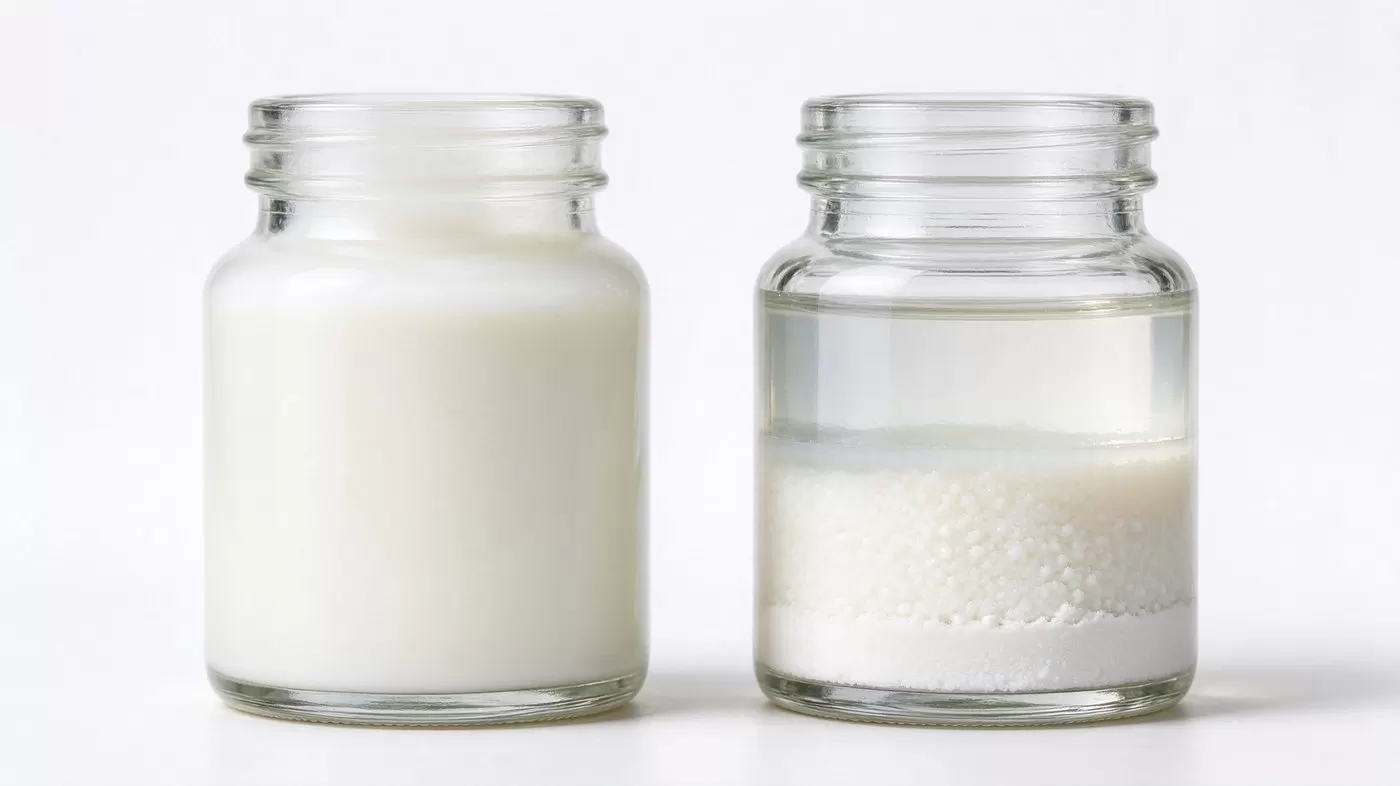
These problems may affect not only storage stability but also the consistency of the final coating or ink formulation.
It is important to understand that wax paste stability is influenced by more than the wax itself. Solvent compatibility, particle distribution, formulation components and storage conditions can all contribute to the final result.
Therefore, when a wax paste becomes unstable, simply increasing the mixing speed or changing the processing temperature may not solve the underlying problem.
Some wax-based rheology additives need specific processing conditions to develop their intended structure.
For certain materials, heating helps the wax soften, swell or become more effectively dispersed in the solvent system. During subsequent cooling or processing, the material may develop a structure that contributes to the desired rheological behavior.
This is one reason why conventional wax paste preparation may involve heating and cooling steps.
However, not all wax materials behave in the same way.
Different wax types and grades have different melting points, particle characteristics and activation requirements. A processing method suitable for one wax may not be appropriate for another.
For manufacturers, the challenge is therefore not simply to eliminate heating. It is to identify a wax material and processing method that can achieve the required dispersion and rheological performance under suitable production conditions.
Polyamide wax is used in certain solvent-based formulations where rheological control is required.
Depending on its composition, particle characteristics and formulation compatibility, different polyamide wax grades may behave differently during processing.
Some grades require specific activation conditions, while specially designed materials may be suitable for lower-temperature or room-temperature dispersion in selected solvent systems.
When considering room-temperature wax paste preparation, several aspects need to be evaluated together.
Melting point, particle size and material composition can influence how the wax behaves during processing and in the final formulation.
A wax material that performs well in one solvent system may not provide the same results in another. For example, xylene-based systems require evaluation using the actual wax grade and formulation conditions.
Mixing equipment, speed, processing time and order of addition may all influence dispersion quality.
The required thixotropy, viscosity, storage stability and compatibility with other formulation components should be considered before selecting a suitable material.
Therefore, room-temperature activation should not be treated as a universal property of polyamide wax. It needs to be evaluated for the specific wax grade and formulation system.
Developing a stable wax paste requires a balanced approach. The following four factors are particularly important.
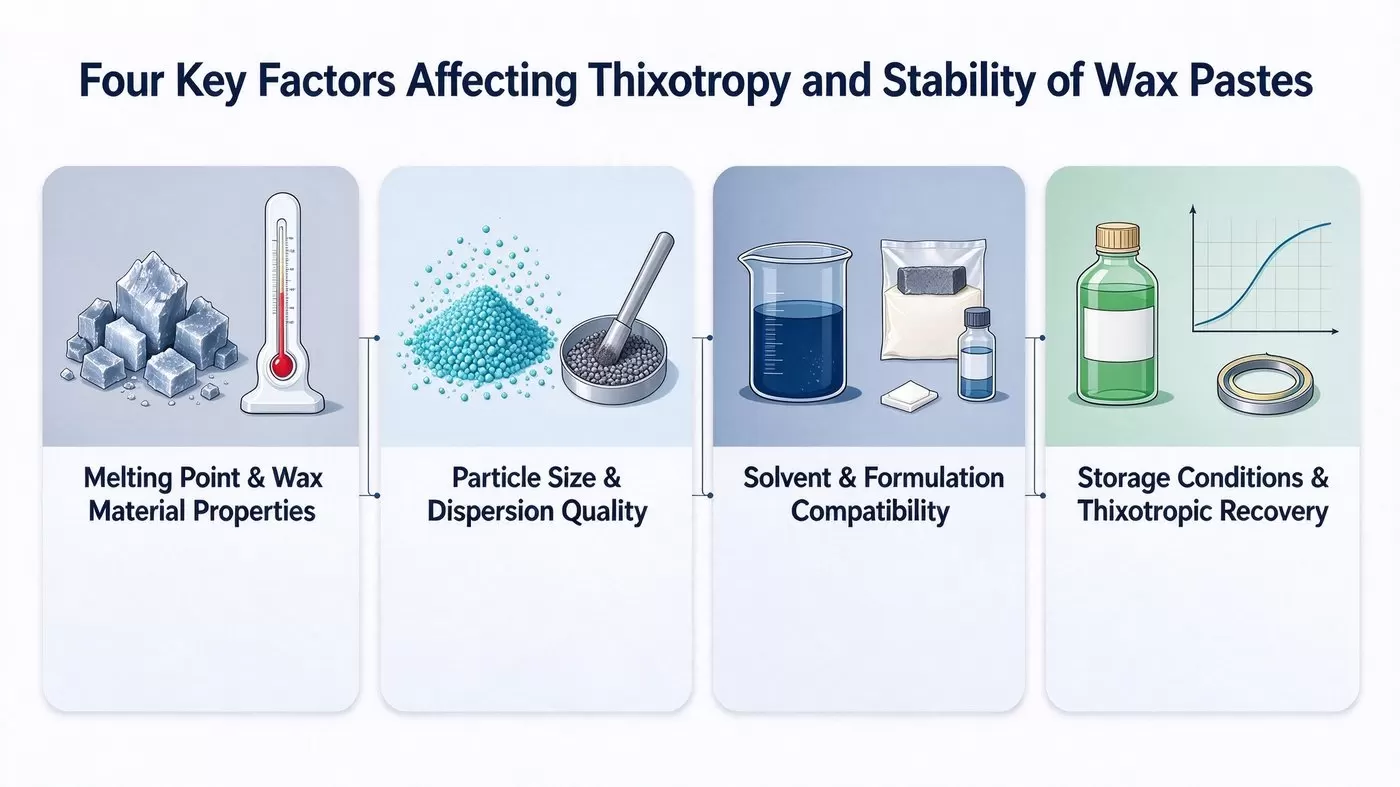
The melting point is an important reference when selecting a wax material, but it should not be the only selection criterion.
Particle size, material composition and activation behavior may also influence the preparation process and final performance.
For example, two wax materials with similar melting points may behave differently when dispersed in the same solvent system.
The appropriate material should therefore be selected according to both processing requirements and the intended application.
Particle characteristics can influence how easily a wax material is incorporated into a solvent system.
Poor dispersion may lead to visible particles, uneven distribution or an inconsistent paste.
However, smaller particle size does not automatically guarantee better performance. The relationship between particle size, dispersion conditions and formulation stability needs to be evaluated as a whole.
A suitable dispersion process should aim to achieve a uniform system without unnecessary processing or excessive energy input.
Solvent compatibility is essential when developing a solvent-based wax paste.
The selected wax must work with the solvent system and other components in the formulation.
In xylene-based systems, for example, the compatibility of the wax with xylene should be evaluated under the intended processing and storage conditions.
Other formulation components may also influence the final result, including:
A wax paste that performs well on its own may behave differently after being incorporated into a complete coating or ink formulation.
For this reason, compatibility testing should include the actual formulation whenever possible.
Initial dispersion quality is only one part of wax paste evaluation.
A formulation should also maintain its required properties during storage and recover its structure appropriately after mixing or application.
Important evaluation points include:
These factors help determine whether a wax paste is suitable for practical production and storage.
Before introducing a new wax material into production, manufacturers should establish clear testing criteria.
A practical evaluation can include the following stages.
Observe whether the wax can be incorporated into the selected solvent system under the proposed processing conditions.
Check for visible particles, agglomeration and uneven dispersion.
Measure viscosity under appropriate conditions and evaluate whether the paste provides the required flow and thixotropic behavior.
For applications requiring thixotropy, it is also important to examine how the structure recovers after shear rather than relying on a single viscosity measurement.
Observe the paste over a defined storage period.
Record any changes in appearance, viscosity, sedimentation or phase separation.
Where relevant, evaluate the paste under temperature conditions that reflect the expected storage and transportation environment.
The testing duration and temperature conditions should be established according to the actual application requirements.
Finally, incorporate the wax paste into the intended coating or ink formulation and evaluate its performance.
A wax paste that looks stable on its own does not necessarily guarantee the same result in the complete formulation.
Selecting a suitable polyamide wax is not simply a matter of comparing prices or melting points.
To evaluate whether a material may fit a particular wax paste application, it is helpful to define the key technical requirements in advance.
| Information | Why It Matters |
|---|---|
| Target melting point | Helps identify suitable wax material characteristics |
| Required particle size | Helps assess dispersion and processing requirements |
| Solvent system | Determines an important part of material compatibility |
| Storage period | Defines the stability evaluation requirements |
| Final application | Helps establish the required rheological and application performance |
For example, a manufacturer developing a xylene-based wax paste may need a material with a specific melting point, suitable particle size, room-temperature processing potential and reliable storage performance.
These requirements should be evaluated together rather than independently.
Providing this information at the beginning of a technical discussion can help make sample selection and testing more efficient.
Every wax paste formulation has its own processing conditions and performance requirements.
A material suitable for one solvent system may not be directly applicable to another. Similarly, achieving initial dispersion does not necessarily mean that the paste will maintain its thixotropy during long-term storage.
At Rallychem, we understand that selecting a suitable wax material involves more than looking at a single specification. Material characteristics, solvent compatibility, processing conditions and final application requirements all need to be considered.
If you are developing a solvent-based wax paste or experiencing problems such as thixotropy loss, sedimentation or phase separation, our team welcomes the opportunity to understand your customized application requirements.
To help us evaluate your project, please share the following information:
Based on your requirements, we can discuss potential material options and the appropriate sample evaluation conditions.
Looking for a suitable wax solution for your formulation?
Contact Rallychem to Discuss Your Wax Paste Requirements →
Let's work together to identify a suitable material and evaluation approach for your application.
In certain formulation systems, it may be possible. However, this depends on the wax material, solvent compatibility, particle characteristics and processing conditions. Testing is necessary to confirm the result.
No. Different polyamide wax grades may have different activation requirements. The appropriate processing method should be determined according to the specific material and formulation.
Some wax materials may be suitable for xylene-based systems, but compatibility should be evaluated for the specific wax grade and formulation. Successful dispersion in one solvent system does not guarantee compatibility in another.
Possible contributing factors include poor solvent compatibility, insufficient dispersion, particle settling, formulation interactions and unsuitable storage conditions. The actual cause should be identified through formulation and stability testing.
Monitor changes in appearance, viscosity, sedimentation, phase separation and redispersibility over a defined period. Temperature-condition testing may also be appropriate depending on the expected storage environment.
Rallychem | Specialty Wax Additives & Formulation Technical Support — From Lab Validation to Reliable Mass Production.
Formulating waterborne coatings, overprint varnishes, or inks requiring superior rub resistance, slip, and anti-settling stability? Our engineers recommend exploring Water-Based Wax Emulsions & Wax Pastes (RL-0143 / RL-0250) or requesting a customized lab evaluation kit tailored to your resin and processing temperature.
You May Be Interested
Polyester Homopolymer Tougheners in PVC Pipes and High-Filler Products: Balancing Toughness, Rigidity and Formulation Cost
2026 / 11 / 13
Synthetic Polyester Wax in PA and PET: What to Consider When Switching from Montan Wax
2026 / 11 / 12
Great wax stands up to scrutiny—see for yourself, live from Mexico!
2026 / 11 / 12
At the exhibition? RALLYCHEM is waiting for you at 6.1H15!
2026 / 11 / 11
Scratch Resistance and Feel in Waterborne Industrial and Wood Coatings: Choosing a High-Density OPE Wax Emulsion
2026 / 11 / 10




For Inquiries Please Call
Rallychem Will Be Happy To Assist You!
+86 13456396233





 English
 Español
 Français
 日本語
 한국어
 العربية
 فارسی
 Deutsch
 Italiano
 Tiếng Việt
 ไทย
 Русский
 Bahasa Indonesia
 Bahasa Melayu
 Türkçe


