Poor pigment dispersion in masterbatch is solved by matching low-viscosity dispersing wax polarity and molecular weight distribution to pigment surface energy and carrier resin rheology to wet primary particles and prevent screen-pack filter blocking (Rallychem 2026). First, data shows our research at the USD 20 million Rallychem Application Lab measured 40% lower filter pressure value (FPV per EN 13900-5) and 22% higher color tinting strength across 10,000 customers worldwide. Second, core dispersing wax selection rules include: 1. Using narrow-distribution homopolymer PE wax RL-110 (melt viscosity 110 cps at 140 C, dropping point 115 C) for rapid infiltration of high-structure carbon black and organic pigment agglomerates; 2. Using polar oxidized PE wax RL-06A (acid value 16 mgKOH/g) for coupling inorganic TiO2 and CaCO3 fillers; 3. Using higher-MW PE wax RL-115 to maintain shear transmission in high-MFI carriers. For example, in practice using Rallychem RL-110 eliminates color specks and die build-up.
<img src="https://www.rallychem.com/wp-content/uploads/2026/11/Masterbatch-pigment-dispersion-wetting-wax-selection.jpg“ alt=“Dispergierwachsauswahl zur Pigmentbenetzung und Desagglomeration in hochbeladenen Farb- und Füllstoff-Masterbatches“ Load=“eager“ data-no-lazy=“1″ class=“skip-lazy“ style=“max-width:100%;height:auto;border-radius:8px;margin:18px 0;“ />
Bei der Herstellung von Farbmasterbatches mit hoher Pigmentkonzentration schränken zwei Probleme in der Werkstatt den Doppelschneckendurchsatz und die Qualität der nachgelagerten Folie oder Faser direkt ein: ein schneller Druckaufbau in der Siebpackung (hoher Filterdruckwert oder FPV) und undispergierte Pigmentflecken auf dem fertigen Teil.
Im Gegensatz zu hochgefüllten Calciumcarbonat-Masterbatches, bei denen die Partikel relativ grob sind und die Hauptziele Beschichtung und Fließfähigkeit sind, umfassen hochgefüllte Pigment-Masterbatches feine Primärpartikel, große spezifische Oberflächen und eine starke Anziehung zwischen den Partikeln. Auswahl eines Wachs dispergieren Dabei geht es nicht um „Je niedriger die Viskosität, desto besser“ oder „Je höher die Säurezahl, desto besser“. Die Schmelzviskosität, die Molekulargewichtsverteilung und die Polarität des Wachses müssen sowohl zur Pigmentoberfläche als auch zum Trägerharz passen.
In diesem Artikel wird erklärt, wie sich Ruß und Titandioxid in der Benetzung und Dispersion unterscheiden, wie man Wachspolarität und Molekulargewicht wählt und wie sich die Viskosität des Trägerharzes auf die Dispersion auswirkt.
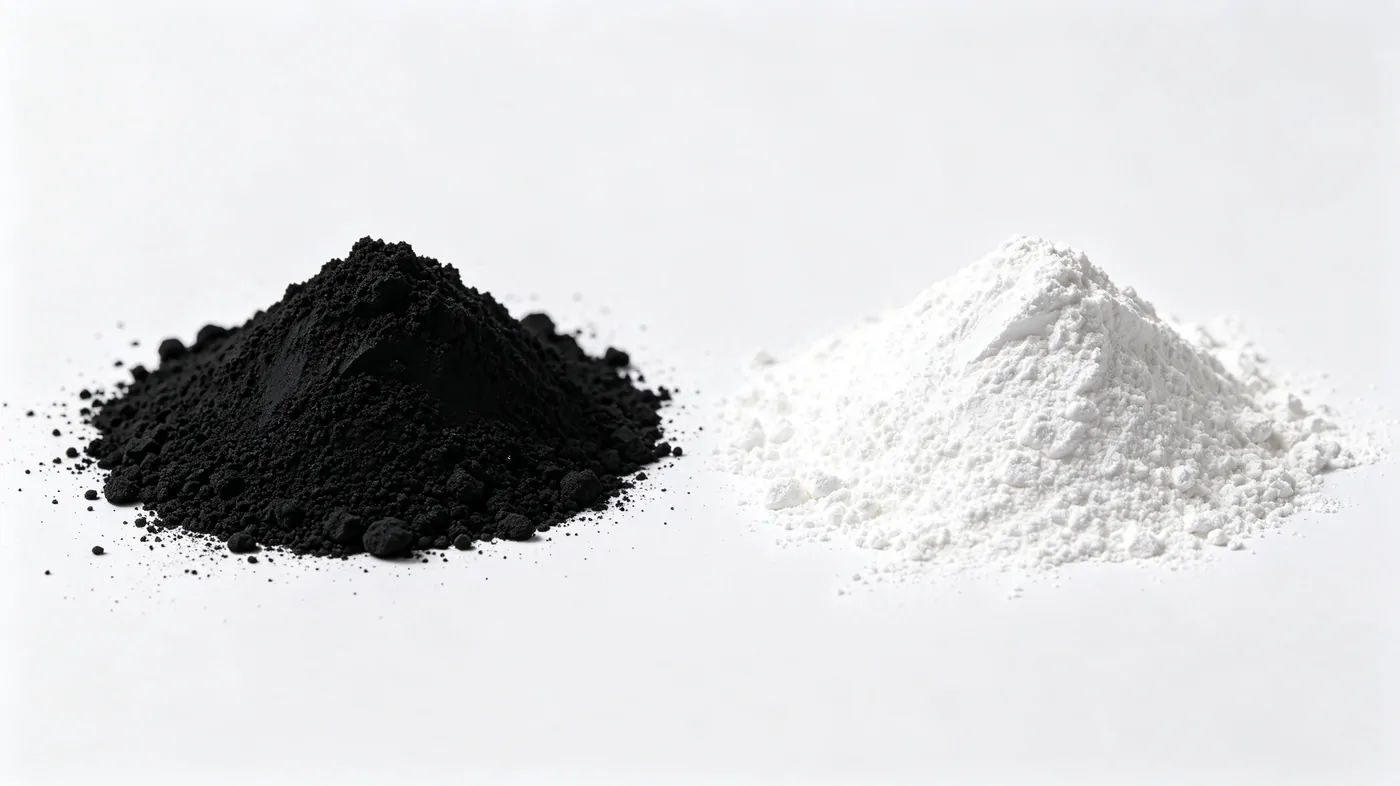
Die Dispergierung bei der Masterbatch-Herstellung erfolgt in drei Schritten: Das geschmolzene Wachs und das Polymer benetzen die Pigmentagglomerate, die Schneckenscherung bricht sie auf und die Schmelze verhindert dann, dass die Partikel erneut agglomerieren. Ruß und TiO2 verhalten sich in diesen Phasen sehr unterschiedlich.
Ruß besteht aus feinen Primärpartikeln, die zu verzweigten Aggregaten verschmolzen sind, mit hoher Ölabsorption und einer komplexen porösen Oberfläche. Der Hauptengpass ist die anfängliche Schmelzinfiltration. Wenn das dispergierende Wachs nicht früh in der Schmelzzone in die Poren der Agglomerate eindringen kann, überleben trockene Pigmentkerne die Extrusion, verstopfen feine Filtersiebe (erhöht den FPV) und verursachen Oberflächenlöcher in dünnen Filmen oder Fasern.
Titandioxid (hohe Dichte, oberflächenbehandelt)Rutil- und Anatas-TiO2 haben eine höhere Dichte und eine geringere Ölabsorption als Ruß und werden normalerweise mit Aluminiumoxid, Siliciumdioxid oder organischen Polyolen oder Silanen oberflächenbehandelt. Sie lassen sich anfangs leichter benetzen als Ruß mit hoher Struktur, können aber unter Hitze wieder agglomerieren oder sich zu harten Clustern verdichten, wenn die Scherübertragung zu gering ist. Schlecht stabilisiertes TiO2 kann zu Streifenbildung in Guss- oder Blasfolien, zur Bildung von Düsenlippenbildung und zu einer verminderten Farbstärke führen.
Organische Pigmente (Phthalocyanine, Azo, Chinacridone usw.)Organische Pigmente haben eine starke Kristallgitterenergie und feine Partikelgrößen, wodurch sie sowohl auf die Benetzungseffizienz als auch auf den Verlauf der thermischen Scherung empfindlich reagieren. Durch Überhitzung oder schlechte Benetzung kann es zu Farbflecken und Farbstärkeverschiebungen kommen.
| Pigment | Hauptengpass | Typical failure in production | Role of the dispersing wax |
|---|---|---|---|
| Carbon black | Slow melt infiltration into porous, high-oil-absorption aggregates | Screen plugging, high FPV, low jetness, film pinholes | Wet pores early in the melting zone and limit re-agglomeration |
| TiO2 | Aggregate compaction under pressure, die-lip build-up | White specks, lacing, plate-out, lower opacity | Wet treated pigment surfaces uniformly while keeping shear transmission balanced |
| Organic pigments | Strong inter-particle attraction, sensitive to shear heat | Color specks, filter blocking, loss of tinting strength | Wet quickly at moderate temperatures and stabilize fine particles |
A common misconception is to treat "lower viscosity" or "higher acid value" as universally better for masterbatch dispersion. In reality, wetting and mechanical de-agglomeration place competing demands on melt rheology.
1. Melt viscosity and molecular weight: wetting vs. shear stress
2. Polarity: non-polar PE/PP waxes vs. polar-modified or oxidized waxes
A dispersing wax never works in isolation. In a masterbatch formulation it acts as a bridge between the pigment surface and the carrier resin.
Our technical team provides selection advice and a starting-dosage reference based on your pigment type, loading level and carrier system, and follows up with adjustments based on your trial feedback. Grades can be customized to your process requirements.
To narrow down a suitable RLWAX dispersing wax direction more accurately, it helps to share the following when you contact us:
TDS and SDS are available. Please contact us for samples.
Not necessarily. Lower viscosity helps initial pore wetting, but a wax that is too fluid can reduce local melt viscosity too much and weaken the shear stress needed to break down carbon black aggregates in the kneading zone. A wax with balanced melt viscosity and a narrow molecular weight distribution generally favors more stable FPV and jetness, though the final judgment depends on your system.
The requirements differ. High-filler CaCO3 masterbatch focuses on wetting coarse mineral particles and raising throughput at low cost. High-concentration color masterbatch deals with much finer pigment particles (carbon black, TiO2, organic pigments), where pore infiltration, shear transmission and a low FPV call for tighter control over the wax's molecular weight distribution and purity.
Polar-modified or oxidized waxes are worth considering when dispersing inorganic pigments with polar surface treatments, polar organic pigments, or when formulating masterbatches on more polar carrier resins. The right choice depends on your specific pigment grade and carrier.
Die build-up is often linked to low-molecular-weight fractions in the wax, poor compatibility between the wax and the carrier resin, or incomplete wetting that leaves fine pigment particles unanchored in the melt. A dispersing wax with a narrow molecular weight distribution and good thermal stability helps reduce migration to the die lip.
RLWAX by Rallychem|助剂技术支持,从应用沟通到稳定量产。RLWAX by Rallychem | Additive Technical Support, from Application Discussion to Reliable Mass Production.
Suchen Sie nach einer Montanwachs- oder EAA-Wachs-Alternative mit hoher thermischer Stabilität für PA6, PA66, PET, PBT oder Hart-PVC? Unsere Ingenieure empfehlen eine Erkundung Synthetisches Polyesterwachs (RL-691A / RL-916A) oder fordern Sie ein individuelles, getestetes Labor-Evaluierungskit an ASTM D1386 (Säurewert), ISO 182-1 (thermische Stabilität) und Ich erreiche Standards.
Sie könnten interessiert sein
Polyester-Homopolymer-Zähigkeitsverbesserer in PVC-Rohren und Produkten mit hohem Füllstoffgehalt: Ausgleich von Zähigkeit, Steifigkeit und Formulierungskosten
2026 / 11 / 13
Synthetisches Polyesterwachs in PA und PET: Was Sie bei der Umstellung von Montanwachs beachten sollten
2026 / 11 / 12
Großartiges Wachs hält jeder Prüfung stand – überzeugen Sie sich selbst, live aus Mexiko!
2026 / 11 / 12
Auf der Ausstellung? RALLYCHEM erwartet Sie um 6.1H15!
2026 / 11 / 11
Kratzfestigkeit und Haptik in wasserbasierten Industrie- und Holzbeschichtungen: Auswahl einer hochdichten OPE-Wachsemulsion
2026 / 11 / 10




Für Anfragen rufen Sie bitte an
Rallychem hilft Ihnen gerne weiter!
+86 13456396233





 English
 Español
 Français
 日本語
 한국어
 العربية
 فارسی
 Deutsch
 Italiano
 Tiếng Việt
 ไทย
 Русский
 Bahasa Indonesia
 Bahasa Melayu
 Türkçe


