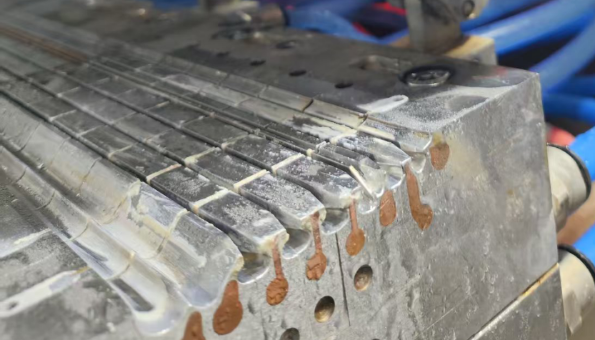
During PVC extrusion, white deposits may appear on the die, die lip, or sizing section. This is a problem that many manufacturers encounter.
On the production floor, it is often simply called “white powder.”
From a technical perspective, however, white powder is only the visible phenomenon. It does not directly tell us what the deposit actually is.
It is more accurately described as a form of plate-out or deposition that occurs during PVC processing. The deposits may come from lubricants, stabilizers, fillers, or other formulation components, and may also be related to processing conditions or system compatibility. In some cases, the deposit may even be a mixture of several components.
01 | What Is White Powder? Is It Because There Is Too Much Lubricant?
During PVC processing, the different components in the formulation need to maintain an appropriate state of dispersion and compatibility within the resin system.
When certain components cannot remain stable under the current formulation or processing conditions, they may migrate toward the melt surface and gradually form deposits on metal surfaces such as the die and die lip.
This is what we see on the production line as “white powder.”
The composition of the deposits can vary from one system to another.
Possible sources include:
-
Lubricants and related components;
-
Stabilizers or components related to stabilizer reactions;
-
Inorganic fillers such as CaCO₃;
-
Other formulation components or substances formed during processing.
Therefore, the appearance of a white deposit does not automatically mean that “there is too much lubricant.”
This is also why repeatedly changing lubricants sometimes fails to solve the problem.
02 | White Powder Is Only the Symptom. Continuous Build-Up Is the Real Problem
A small amount of occasional deposition may not immediately affect production. However, if plate-out continues and gradually accumulates, it can lead to several problems.
Ø First, production stability.
As deposits continue to build up on the die, the line may need to be stopped frequently for cleaning, affecting continuous production.
Ø Second, product surface quality.
Once the build-up reaches a certain level, it may transfer onto the product surface, causing flow marks, scratches, white marks, and other appearance defects.
Ø More importantly, repeated plate-out often indicates that there may be some kind of mismatch between the current formulation system and processing conditions.
So the real question is not:
“How do we clean the white powder?”
It is:
“Why does it keep forming in the first place?”
03 | How Can We Find Out What the White Powder Actually Is?
This is actually the most critical step in the entire process.
Deposits from different sources often show different characteristics.
Ø Stabilizer-related:
If color changes, localized scorching, or a narrower processing window occur at the same time, it is worth checking the stabilizer system as well as the actual processing temperature and thermal history.
Ø CaCO₃-related:
If the white powder is relatively dry and has an obvious powdery appearance, especially if the problem occurs after changing the filler batch or increasing the filler loading, the particle size, surface treatment, and dispersion state of the CaCO₃ should be checked.
Ø Lubrication-system-related:
If the deposit has an obvious waxy or oily appearance, the compatibility between different lubricant components, their addition levels, and their migration behavior during processing should be further examined.
These observations can only serve as clues. The composition of the white powder cannot be determined based on appearance alone.
We generally recommend collecting a small amount of the deposit for analysis.
Depending on the actual situation, analytical methods such as FTIR, XRF, SEM-EDS, and TGA can be used to evaluate the deposit from different perspectives, including organic components, elemental composition, and thermal behavior.
For example:
-
FTIR: Helps identify characteristic features of organic materials and some inorganic components;
-
XRF / SEM-EDS: Helps analyze elemental composition and identify possible inorganic sources;
-
TGA: Uses thermal weight-loss characteristics to assist in evaluating the composition of different components.
By combining these analytical results with the customer’s formulation, raw materials, and processing conditions, we can further narrow down the possible source of the deposit.
Relevant PVC plate-out studies have also used methods such as FTIR, SEM-EDX, and thermal analysis to identify the composition of deposits collected from actual production lines.
First find out “what it is,” then determine “why it formed,” and only then decide “what to adjust.”
04 | Once the Source Is Identified, Then Decide How to Solve It
Ø If the analysis confirms that the deposit is mainly related to the lubrication system, the compatibility between different lubricant components and the current processing conditions should be examined further;
Ø If a relatively high proportion of inorganic components is found, further investigation should be carried out in combination with raw materials such as CaCO₃ and stabilizers;
Ø If the composition of the deposit does not change significantly, but the problem becomes noticeably worse after changes in production conditions, then processing conditions such as temperature, shear, and plasticization state also need to be examined.
Therefore, an effective solution is usually not simply:
“White powder → Change the lubricant.”
Instead, it is:
“Collect and analyze the deposit → Identify its composition → Trace the source → Analyze the cause based on the formulation and processing conditions → Make targeted adjustments.”
05 | A Real Case: Why Did the Die Start “Oozing Oil” After 48 Hours of Production?
We once participated in a PVC pipe project.
The customer was facing a relatively typical problem: after approximately 48 hours of continuous production, an oily deposit began to appear around the die opening.
At first, the problem was not obvious. But as production continued, the deposit gradually increased and accumulated.
The customer had to stop the line and clean the die. After restarting production, the same problem would appear again after a certain period of time.
The customer suspected that “too much lubricant had been added,” so they reduced the lubricant dosage. As a result, the material directly scorched during extrusion.
After we understood the situation, we asked the customer to collect approximately 2 g of the deposit and send it to the Rallychem R&D Center for FTIR analysis.
The results showed clear characteristics associated with polyethylene / long-chain aliphatic hydrocarbons, indicating that the deposit was likely to contain PE wax or a similar hydrocarbon-based component. We therefore narrowed the investigation down further to the low-density wax used in the original lubrication system.
We then compared the result with the raw materials in the customer’s existing formulation and basically determined that the problem was not simply that “too much low-density wax had been added.”
The customer’s original formulation had already been running normally. What had actually changed was that, during continuous production, this component gradually migrated toward the die surface and accumulated there.
Therefore, we did not simply reduce the dosage of the low-density wax.
Instead, we re-adjusted the fixed lubricant combination and ratios in the original formulation, making the different lubricant components more compatible with the current PVC formulation and processing conditions.
After the adjustment, die deposition was significantly reduced, the frequency of die cleaning decreased, and production stability also improved.
This case showed us that:
What we call “white powder” is only the visible result. The deposit itself is what needs to be investigated.
First find out “what is being deposited,” then determine “why it is depositing,” and finally decide “what should be adjusted.”
If you are currently experiencing recurring PVC die white powder, plate-out, or die build-up, you can share the deposit photos, location where it appears, production symptoms, and information about your current formulation and raw materials with us.
Let’s first identify the cause, and then decide how to adjust the system.
Rallychem | From a production symptom to the right direction for solving the problem.











 English
  Español
  Français
  日本語
日本語  한국어
한국어  العربية
  فارسی
فارسی  Deutsch
  Italiano
  Tiếng Việt
  ไทย
ไทย  Русский
  Bahasa Indonesia
  Bahasa Melayu
  Türkçe


